Molly fish are active, hardy, and great at grazing on algae—making them a favorite for community aquariums with harder, more alkaline water. They’re livebearers, so they also breed easily for hobbyists who want to raise their own fish.
In one sentence: Molly fish (Poecilia sphenops and related species) are hardy, mostly peaceful livebearers that thrive in groups in a heated, filtered 20+ gallon aquarium with moderately hard to hard, alkaline water.
1. Introduction & Quick Facts
Common Name: Molly, Molly fish
Scientific Names (common aquarium mollies):
- Short-finned molly – Poecilia sphenops
- Sailfin molly – Poecilia latipinna
- Yucatan sailfin molly – Poecilia velifera
Most pet store mollies are hybrids of these species, selectively bred for color and fin shape.
Molly Quick Stats
| Parameter | Recommended Value |
|---|---|
| Care Level | Beginner to Moderate (easy fish, but sensitive to soft/acidic water) |
| Temperament | Peaceful to semi-aggressive; males can be pushy |
| Size at Maturity | 3–4 in (7.5–10 cm) typical; large sailfins up to 5–6 in (12–15 cm) |
| Minimum Tank Size | 20 gal (75 L) for a small group; 30+ gal (110+ L) strongly preferred |
| Water Temperature | 72–80°F (22–27°C), ideal 75–78°F (24–25.5°C) |
2. Comprehensive Overview
Natural Origin & Habitat
- Native to:
- Mexico, Central America, and parts of northern South America.
- Habitats:
- Slow-moving rivers and streams
- Coastal lagoons and estuaries
- Ditches and ponds
- Many wild mollies live in slightly brackish or mineral-rich waters:
- Warm
- Hard to very hard
- Slightly alkaline (high pH)
This is why mollies often struggle in very soft, acidic tap water—they’re adapted to mineral-rich environments.
Appearance & Color Variations
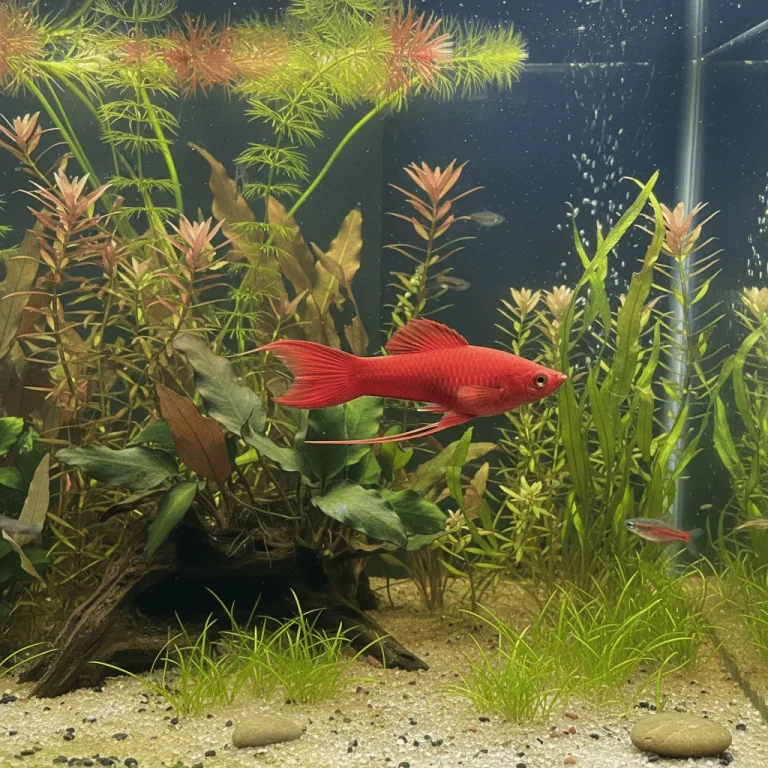
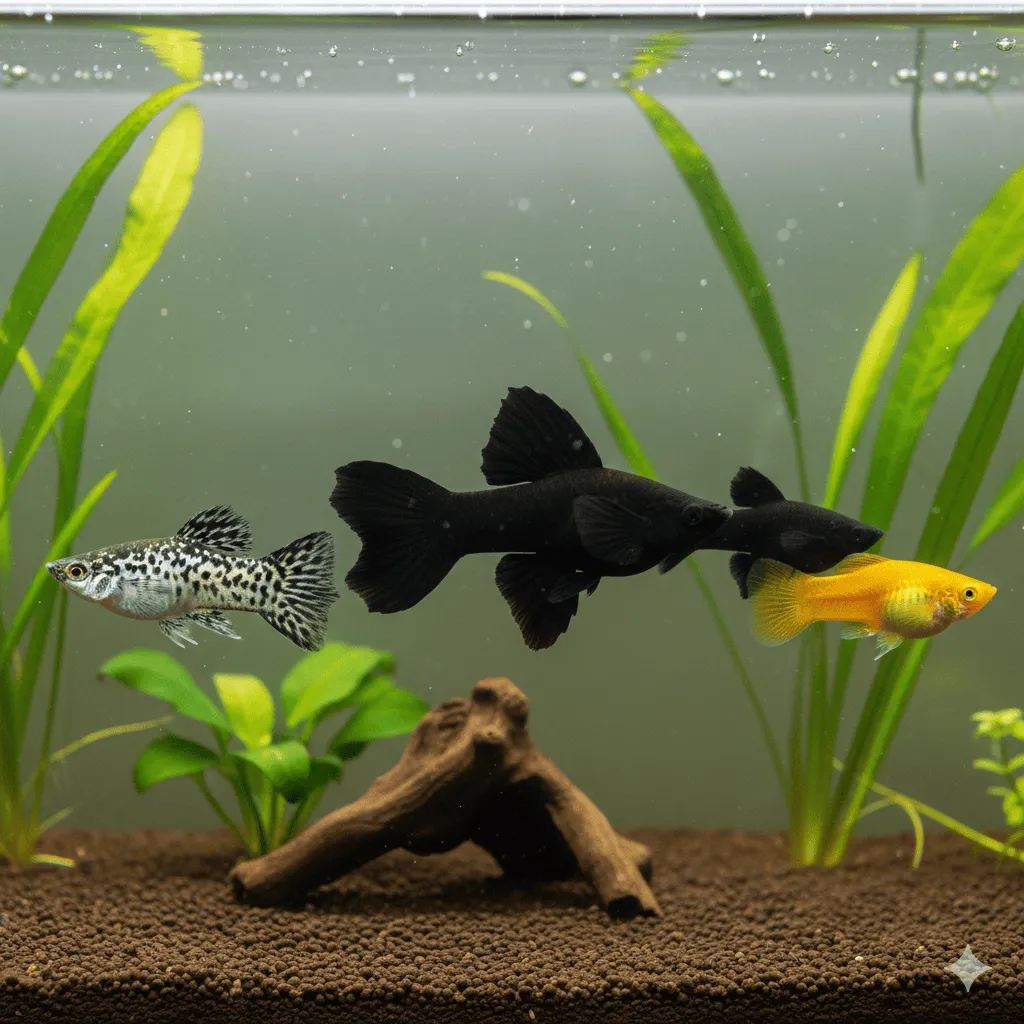
Mollies are medium-sized livebearers with a torpedo-shaped body and a fan-shaped tail. Sailfin forms have a large, high dorsal fin that looks like a little sail.
Typical size:
- 3–4 in (7.5–10 cm) for common short-finned mollies
- 4–6 in (10–15 cm) for sailfin and Yucatan mollies, especially females
Popular color and fin morphs:
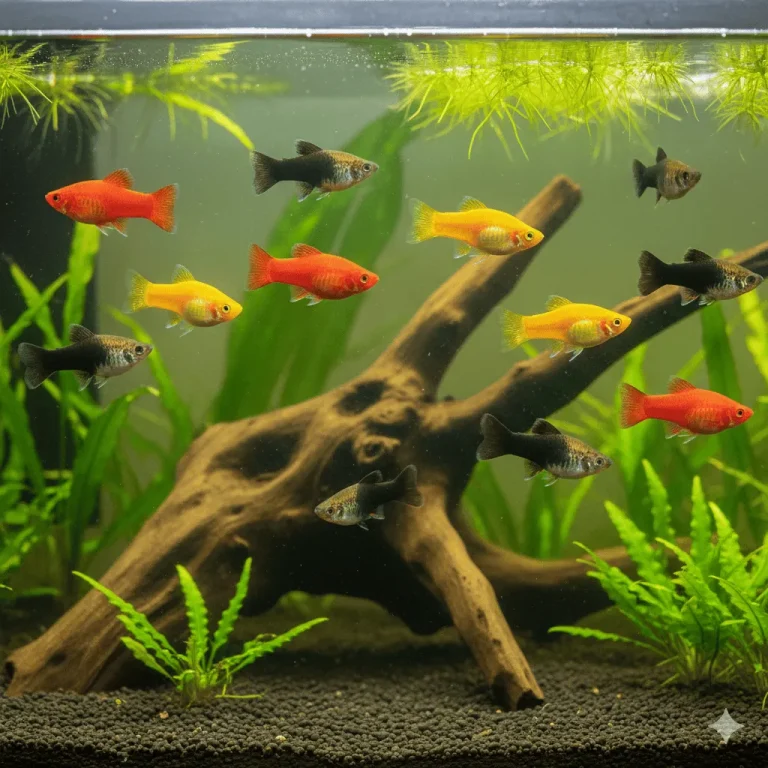
- Black Molly: Solid velvet-black body and fins.
- Dalmatian Molly: White or silver base with black spots.
- Gold / Sunset Molly: Yellow to orange body, often with darker fins.
- Marble / Calico Molly: Patchy black, white, and orange patterns.
- Lyretail Molly: Extended, lyre-shaped tail fins.
- Sailfin Molly: Tall, impressive dorsal fin with spotting or banding.
- Balloon Molly: Short, rounded body due to selective breeding (note: can have health/welfare concerns).
Males are often slimmer with more prominent dorsal fins (especially sailfins), while females are larger and deeper-bodied.
3. Tank Requirements & Setup
Mollies are active, relatively large livebearers and need more space than guppies or platies.
Tank Size
- Minimum: 20 gallons (75 L) for a small group (e.g., 1–2 males with 3–5 females).
- Recommended: 30 gallons (110 L) or larger, especially for:
- Sailfin mollies
- Heavier stocking
- Mixed community tanks
Keep more females than males (e.g., 2–3 females per male) to spread out male attention.
Filtration
Mollies are high-waste fish and prefer clean, well-oxygenated water.
- Filter types:
- HOB (Hang-On-Back) filter: Ideal for 20–40 gallon tanks.
- Canister filter: Excellent for larger tanks and heavy stocking.
- Sponge filters: Great for fry/grow-out tanks and supplemental filtration.
- Flow:
- Moderate flow is well tolerated and even appreciated.
- Avoid extremely strong current in small tanks where fish can’t escape it.
(Affiliate opportunities: mid/high-end HOBs, canister filters, sponge filters, and bio-media.)
Temperature & Heater
- Ideal temperature: 75–78°F (24–25.5°C).
- Use a reliable adjustable heater sized for your tank (typical guideline: 3–5 W per gallon).
- Always pair with a digital aquarium thermometer to verify the temperature.
Lighting
- Moderate lighting is usually sufficient:
- Shows off their colors.
- Supports live plants and algae growth (which mollies graze on).
- LED strip or bar lights with adjustable intensity and a timer are ideal.
Decor & Aquascaping
Think “open swimming space with structured planting”:
- Substrate:
- Fine gravel or sand.
- Hardscape:
- Rounded rocks and driftwood.
- Offer caves or overhangs for retreat.
- Plants:
- Hardy plants that handle harder, brighter conditions:
- Vallisneria
- Amazon swords
- Java fern, Anubias
- Hornwort, water sprite
- Floating plants provide shade and fry cover:
- Frogbit, water lettuce, Salvinia
- Hardy plants that handle harder, brighter conditions:
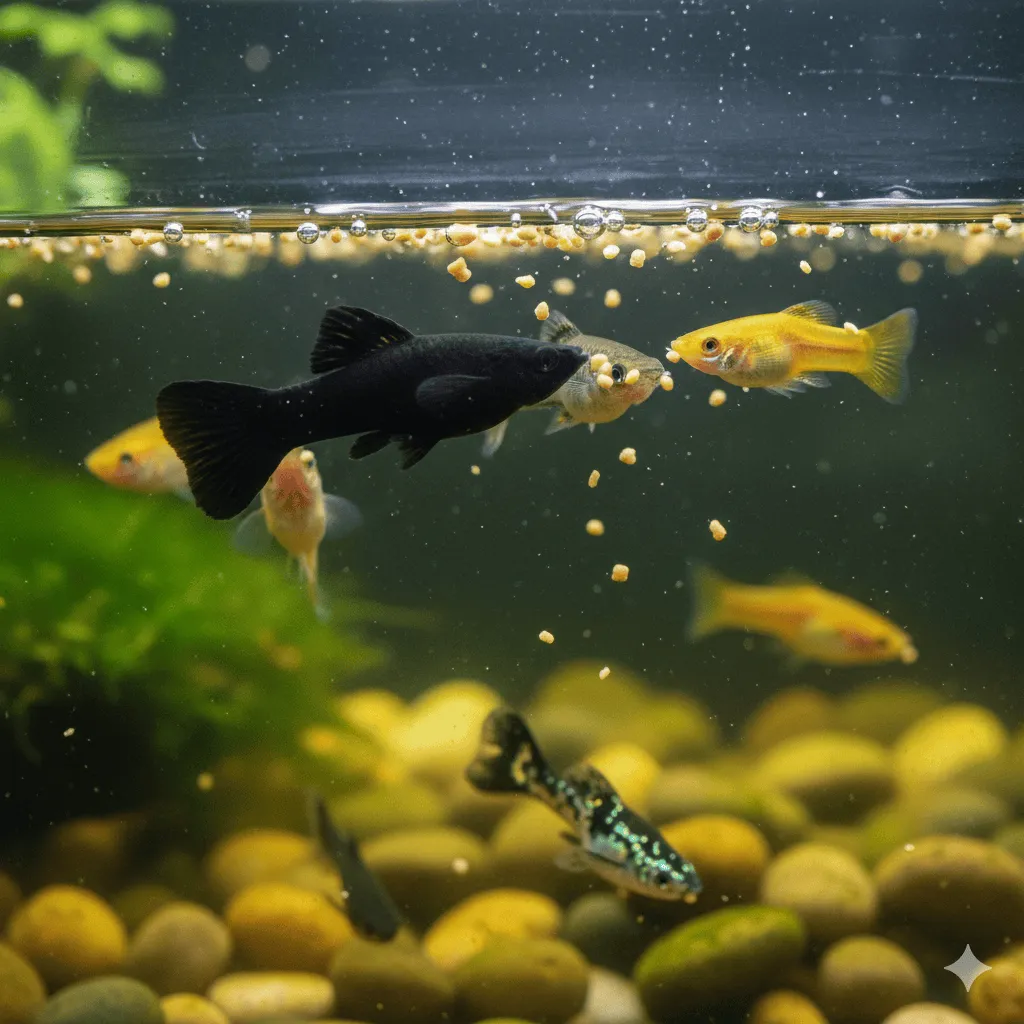
- Mollies appreciate both open areas to swim and vegetated zones to graze and hide fry.
4. Water Quality
Ideal Water Parameters
Mollies are hard-water, alkaline fish:
- pH: 7.5–8.5 (slightly to strongly alkaline).
- GH (General Hardness): 10–30 dGH (moderately hard to very hard).
- KH (Carbonate Hardness): 8–12 dKH (for stable pH).
- Ammonia & Nitrite: 0 ppm at all times.
- Nitrate: Preferably < 20 ppm, max ~40 ppm with good maintenance.
Many mollies benefit from slightly brackish conditions (a small amount of aquarium salt) if:
- You keep no salt-sensitive plants or invertebrates, and
- Tank mates also tolerate mild salinity.
However, they can also do very well in freshwater as long as it is hard and alkaline.
Testing & Maintenance
- Use a liquid test kit to monitor:
- Ammonia
- Nitrite
- Nitrate
- pH
- (Optional) GH/KH if your tap water is unknown or borderline.
- Water changes:
- 25–40% weekly depending on stocking.
- Always treat tap water with a dechlorinator/water conditioner before adding to the tank.
- Rinse filter media in old tank water, not tap water, to preserve beneficial bacteria.
(Ideal spot to promote test kits, GH/KH test strips, water conditioners, and gravel vacuums.)
5. Diet & Feeding
Food Type
Mollies are omnivorous with a strong herbivorous tendency:
- They naturally graze on algae, biofilm, and plant matter.
- A healthy diet must include plenty of vegetable content plus some protein.
What to Feed
- Staple foods:
- High-quality community or livebearer flakes.
- Small pellets formulated for omnivores or livebearers.
- Vegetable-based foods (very important):
- Spirulina flakes or pellets.
- Algae wafers.
- Blanched vegetables: zucchini, cucumber, spinach, peas (skin removed; peas in moderation).
- Protein treats (2–3x per week):
- Frozen or live foods: brine shrimp, daphnia, bloodworms (sparingly), mosquito larvae where legal.
Avoid diets that are too high in fat and animal protein; these can contribute to health issues in livebearers over time.
Feeding Schedule
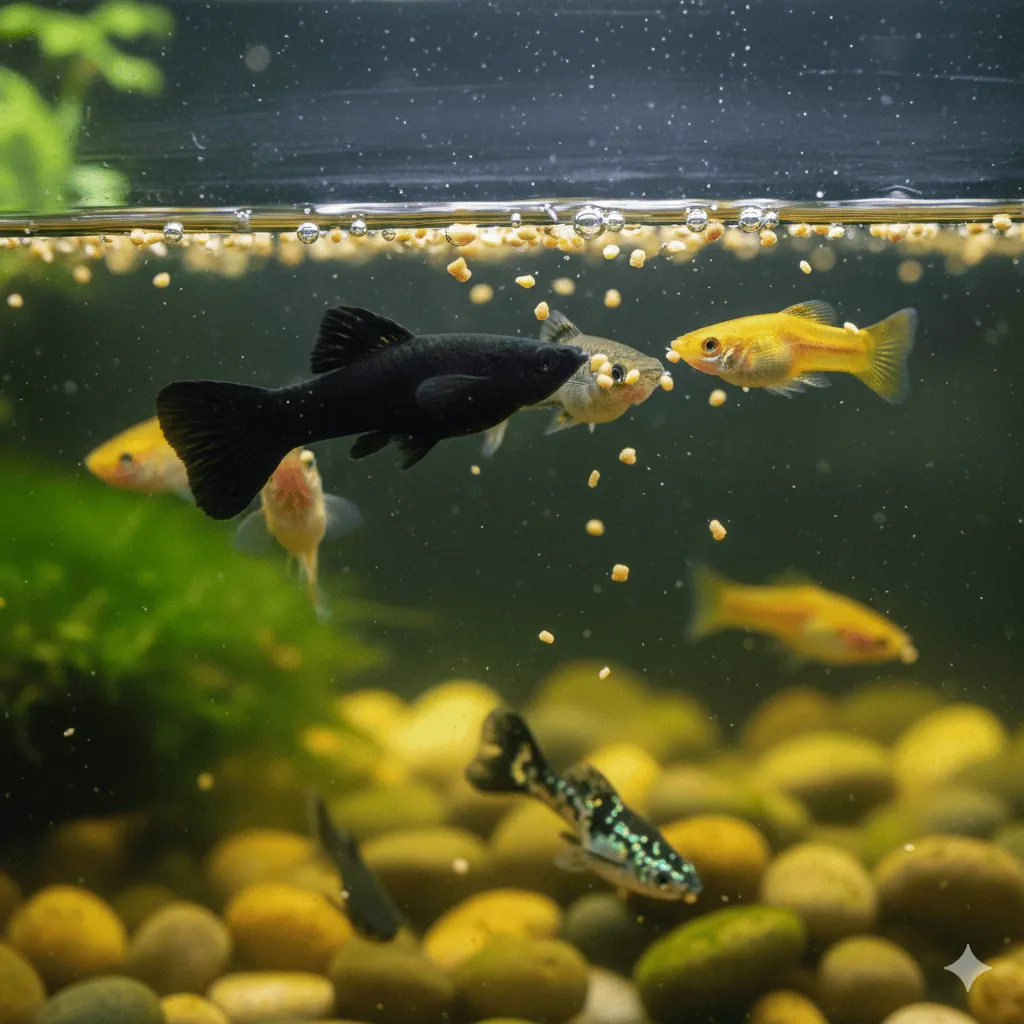
- Frequency: 1–2 times per day.
- Amount: Only what they can consume in 1–2 minutes.
- Remove uneaten food to maintain water quality.
Recommended Food Brands (Examples)
(Adjust according to region and affiliate partners.)
- Flakes & pellets:
- Fluval Bug Bites (community or herbivore), Omega One, Hikari, Tetra, Xtreme, NorthFin.
- Veggie-focused foods:
- Spirulina flakes, algae wafers from well-known aquarium brands.
- Frozen foods:
- Brine shrimp, daphnia, mysis shrimp.
6. Temperament & Tank Mates
Temperament
- Generally peaceful, but:
- Males can be pushy and occasionally nip, especially if overcrowded or outnumbering females.
- Active swimmers that patrol all levels of the tank.
- Work well in community aquariums that match their water needs.
Suitable Tank Mates
Choose species that like hard, alkaline water and are non-aggressive:
- Other livebearers:
- Platies, swordtails, guppies, Endler’s livebearers.
- Peaceful schooling fish (if they tolerate harder water):
- Some danios and rasboras.
- Bottom dwellers:
- Bristlenose plecos
- Some Corydoras species (many adapt to moderate hardness).
- Invertebrates (if no salt is used or salt is minimal):
- Nerite snails, mystery snails (apple snails).
Always research each species’ preferred pH, hardness, and temperature to ensure compatibility.
Unsuitable Tank Mates
Avoid:
- Aggressive or large fish:
- Most cichlids (especially medium/large species), large barbs.
- Known fin-nippers:
- Tiger barbs, Serpae tetras, some larger danios.
- Delicate soft-water fish:
- Discus, many wild-caught tetras and dwarf cichlids (they prefer softer, acidic water).
Also consider that mollies breed readily. If you don’t want lots of fry, either:
- Keep them with fish that will naturally eat some fry, or
- Control breeding groups carefully.
7. Breeding Mollys
Mollies are livebearers and very easy to breed—often without any special encouragement.
Sex Differences
- Males:
- Smaller, slimmer.
- Anal fin modified into a pointed gonopodium (tube-like).
- More pronounced dorsal fins (especially in sailfins).
- Females:
- Larger, fuller bellies.
- Anal fin is a fan shape, not pointed.
- When pregnant, they develop a noticeably swollen abdomen.
Breeding Tank Requirements
While they will breed in a community tank, a dedicated breeding/grow-out tank increases fry survival:
- Tank size: 20–30 gallons (75–110 L).
- Filtration: Sponge filter or gentle HOB for fry safety.
- Temperature: 76–78°F (24.5–25.5°C).
- Setup:
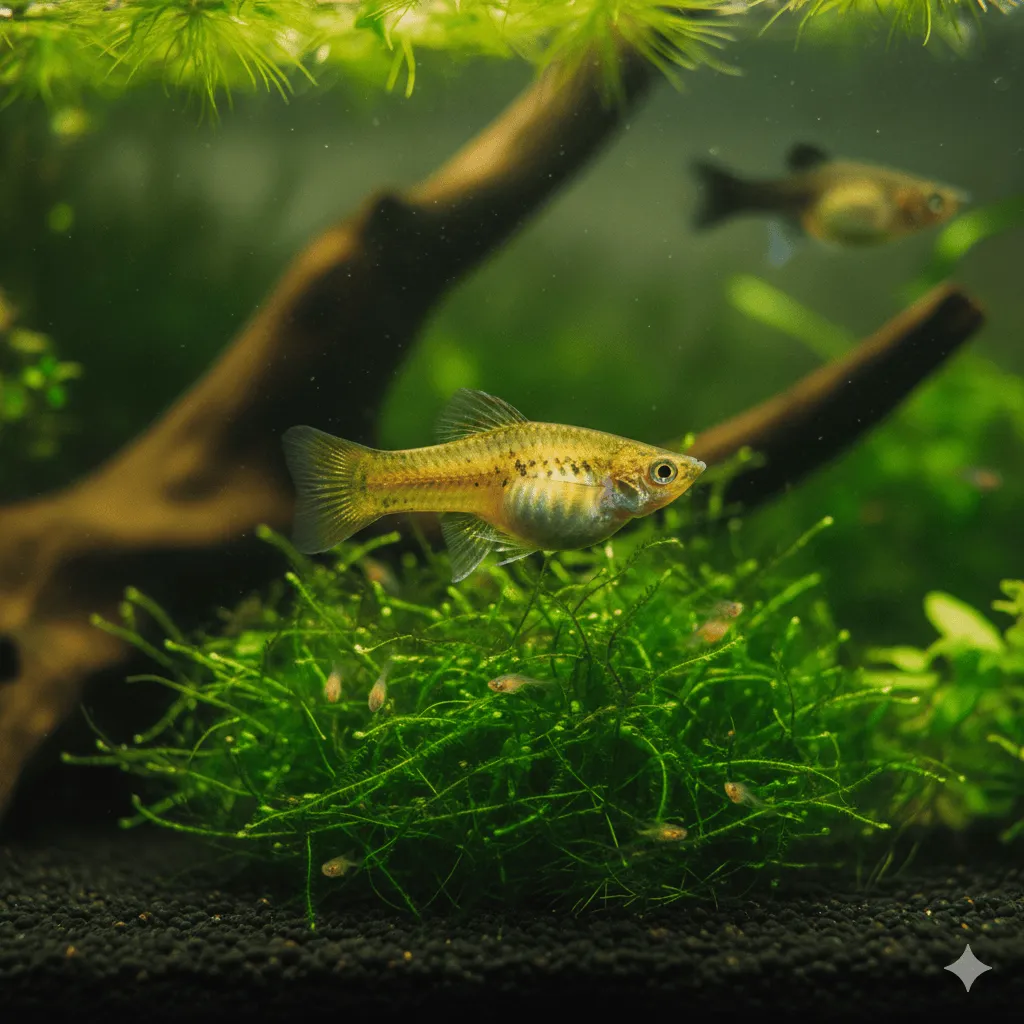
- Dense live plants (Java moss, hornwort, water sprite).
- Floating plants for cover.
- Lots of hiding spots for fry.
Keep a ratio of 1 male to 2–3 females to reduce stress.
Spawning & Care of the Young
- Mating:
- Males inseminate females using the gonopodium.
- One mating can fertilize multiple broods.
- Gestation:
- Roughly 4–6 weeks, depending on temperature and condition.
- Birth:
- Females give birth to fully formed fry.
- A single drop can range from 20–100+ fry in large, healthy females.
- Protecting the fry:
- Adults (including parents) may eat fry.
- Options:
- Move heavily pregnant female to a separate tank shortly before birth.
- Provide dense plants/breeding grass in the main tank.
- Feeding fry:
- Crushed flakes or powdered fry food.
- Baby brine shrimp (excellent for fast, healthy growth).
- Microworms or high-quality liquid fry food.
- Feed small amounts 3–4 times daily.
- Grow-out:
- Frequent small water changes.
- Monitor for overcrowding; move juveniles to larger tanks as needed.
8. Health & Disease
Mollies are hardy, but they have some specific vulnerabilities, especially when kept in soft, acidic water or in cool temperatures.
Common Molly Health Issues
- “Molly Shimmies” (Livebearer Disease)
- Symptoms: Fish vibrates or shimmies in place, clamped fins, lethargy.
- Often caused by:
- Stress from soft, acidic water.
- Low temperature.
- Poor water quality.
- Ich (White Spot Disease)
- Symptoms: White salt-like spots, rubbing on objects, clamped fins.
- Fin Rot & Bacterial Infections
- Symptoms: Frayed fins, red streaks, ulcers, cloudy patches.
- Columnaris
- Often mistaken for fungus.
- Symptoms: Cottony-looking patches around mouth/body, saddleback lesions.
- Fungal Infections
- Symptoms: True fluffy, white cottony growths on fins or body.
- Internal Parasites
- Symptoms: Weight loss, hollow belly, stringy feces, poor growth despite eating.
Early Warning Signs
- Reduced appetite or not eating.
- Hiding or unusual lethargy.
- Rapid breathing, hanging at the surface or bottom.
- Clamped fins or erratic swimming.
- Color fading or spots/patches on skin and fins.
Treatment Recommendations
(Always follow medication instructions and consult a knowledgeable fish vet or experienced aquarist if possible.)
- Check environment first:
- Test ammonia, nitrite, nitrate, pH, and temperature.
- Correct issues and perform partial water changes.
- Ensure water is hard and alkaline enough for mollies.
- Ich:
- Use an ich-specific medication.
- Gradually raise temperature within safe limits if compatible with tank mates.
- Fin rot & mild bacterial issues:
- Improve water quality.
- Consider aquarium salt (if plants/inverts tolerate it) and/or appropriate antibacterial medication.
- Columnaris & serious bacterial infections:
- Treat with strong broad-spectrum antibiotics or antibacterial meds designed for fish.
- “Shimmies”:
- Correct water chemistry (increase hardness and pH if too low).
- Ensure adequate temperature (75–78°F).
- Reduce stress and crowding.
- Quarantine/hospital tank:
- Highly recommended for treating sick fish without exposing the display tank to meds.
(Excellent section to link medications, aquarium salt, quarantine tanks, and water testing products.)
9. Where to Buy Molly Fish
Price Range
- Common mollies (black, dalmatian, gold, short-fin):
- Usually $2–$6 USD per fish.
- Sailfin, lyretail, or rare color morphs:
- Commonly $5–$15+ USD, depending on size and quality.
- Show-quality or rare wild strains:
- Can be higher, especially from specialized breeders.
Trusted Sources
- Local Fish Stores (LFS):
- Wide variety of common color morphs.
- Ability to inspect fish for health and behavior.
- Chain pet stores:
- Very common source for standard varieties.
- Check carefully for signs of disease or overcrowding.
- Online breeders and specialty retailers:
- Higher-quality, unique strains, wild-types, sailfins.
- Look for:
- Live arrival guarantees.
- Good reviews.
- Clear photos of actual or representative stock.
- Fish clubs and hobbyist breeders:
- Often have hardy, locally adapted mollies.
- Great for learning from experienced livebearer keepers.
Choose fish that are active, eating, with no shimmies, spots, frayed fins, or bloated/sunken bellies.
10. Summary & Final Verdict
Is the Molly Fish Suitable for Beginners?
Yes, mollies can be excellent beginner fish—with one important condition:
They are best for beginners who have naturally hard, alkaline tap water or are willing to adjust and maintain those conditions.
Pros:
- Hardy and forgiving once kept in the right water.
- Colorful, active, and interesting behavior.
- Great algae grazers.
- Easy to breed and raise.
Cons:
- Can struggle in soft, acidic water.
- Need more space than smaller livebearers.
- Can overpopulate the tank if breeding is uncontrolled.
Final verdict:
Mollies are a great choice for beginner to intermediate aquarists with 20+ gallon heated tanks and hard, alkaline water, and they are especially rewarding for those interested in livebearers and breeding.
Related Articles (Internal Link Ideas)
Link these to other pages on your site:
- Platy Fish Care: Colorful, Peaceful Livebearers for Any Community Tank
- Guppy Fish: How to Care for the World’s Most Popular Livebearer
- Beginner’s Guide to Setting Up a 20-Gallon Community Aquarium
- How to Test and Adjust Aquarium pH, GH, and KH
- Livebearer Fry Care: Feeding and Raising Baby Guppies, Platies, and Mollies
11. People Also Ask
Q1. Are mollies good beginner fish?
Yes, mollies are good beginner fish if your tap water is moderately hard to hard and alkaline and you can provide a heated, filtered 20+ gallon tank. They’re less suitable for very soft, acidic water.
Q2. Do molly fish need salt?
Mollies don’t require salt if the water is already hard and alkaline, but they often benefit from a small amount of aquarium salt in freshwater or low-end brackish systems, provided tank mates and plants can tolerate it.
Q3. How many mollies can I keep in a 20-gallon tank?
A reasonable stocking is about 5–6 adult mollies in a well-filtered 20-gallon tank, with more females than males. For sailfins or heavier stocking, a larger (30+ gallon) tank is better.
Q4. Can mollies live with guppies and platies?
Yes, mollies mix well with guppies and platies, as they all prefer similar hard, alkaline water and are generally peaceful livebearers. Just watch overall stocking and potential overbreeding.
Q5. How long do molly fish live?
With good care, mollies typically live 3–5 years, and sometimes a bit longer in optimal conditions.
Q6. Why is my molly fish shaking or shimmying?
“Shimmies” often indicate stress, usually due to soft, acidic water, low temperature, or poor water quality. Check and correct your water parameters, temperature, and maintenance routine.
Q7. Do mollies eat algae?
Yes, mollies are excellent algae grazers, especially on soft algae and biofilm. However, they still need a balanced diet that includes high-quality prepared foods and vegetables.
Q8. Do I need a heater for molly fish?
Yes, mollies are tropical fish and thrive at 72–80°F (22–27°C). A reliable aquarium heater is recommended in most homes to keep their temperature stable