For anyone looking for a fish that is hardy, endlessly active, and fun to watch, the Zebra Danio is a perfect choice. These energetic little “rockets” are a cornerstone of the freshwater aquarium hobby, loved by beginners for their forgiving nature and by experts for their interesting behaviors and scientific importance.
This ultimate guide will cover everything you need to know about Zebra Danio care, from setting up the perfect tank to breeding these dynamic and delightful fish.
1. Introduction & Quick Facts
Common Names: Zebra Danio, Zebrafish
Scientific Name: Danio rerio
Zebra danios are one of the most forgiving fish you can keep. They tolerate a wide range of temperatures, are disease-resistant compared to many other species, and are constantly active near the top and middle of the tank.
Zebra Danio Quick Stats
HTML| Zebra Danio Quick Facts | |
|---|---|
| Scientific Name | Danio rerio |
| Care Level | Beginner |
| Temperament | Peaceful, very active schooling fish |
| Size at Maturity | Up to 2 in (5 cm) |
| Minimum Tank Size | 10 gallons / 40 liters (for a small school) |
| Water Temperature | 68–78°F (20–26°C), ideal 72–76°F (22–24°C) |
| pH Range | 6.5–7.5 |
| Water Hardness | 5–19 dGH (soft to moderately hard) |
| School Size | Minimum 6, ideally 10–15+ |
| Lifespan | 3–5 years in captivity (sometimes longer) |
2. Comprehensive Overview
Origin & Natural Habitat
Zebra danios are native to South Asia, particularly:
- India
- Bangladesh
- Nepal
- Bhutan
- Pakistan
They are mostly found in:
- Slow-moving streams and rivers
- Irrigation ditches
- Floodplains and rice paddies
Wild habitats are often:
- Shallow
- Well-oxygenated
- With mixed gravel/sand substrates
- Vegetation along the banks
They’re adapted to a range of temperatures, which is why they’re often recommended as subtropical aquarium fish – but they do very well in standard tropical tanks too.
Appearance & Color Variations
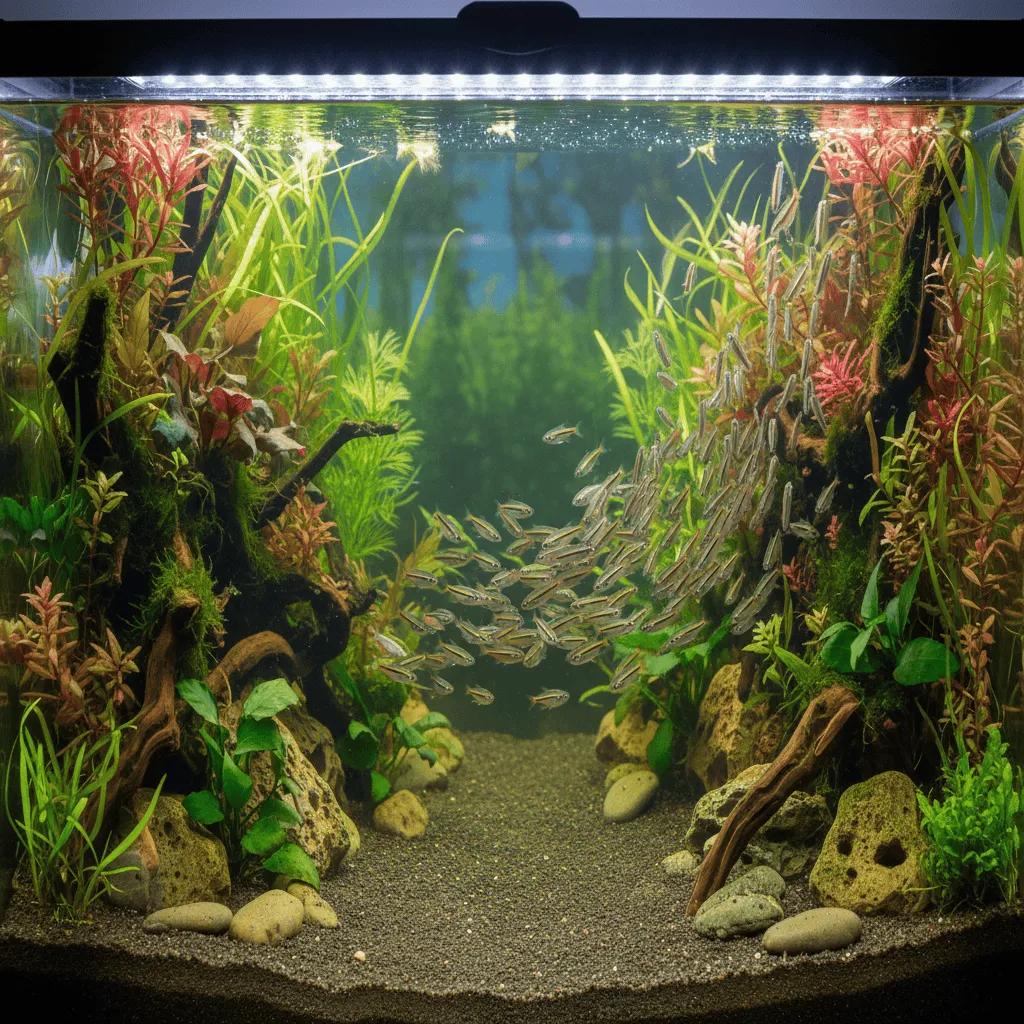
The classic zebra danio has:
- A slim, torpedo-shaped body
- 5–6 horizontal blue/purple and silver/gold stripes from head to tail
- Clear to slightly yellowish fins
- A forked tail
Popular Color Morphs & Varieties
Due to selective breeding, many color and fin variants exist:
- Standard Zebra Danio:
- Blue/purple horizontal stripes over silver/gold body
- Long-Fin Zebra Danio:
- Elongated, flowing fins
- Golden Zebra Danio:
- Lack of dark pigment; golden body with white/cream stripes
- Leopard Danio (closely related species):
- Spotted pattern instead of stripes (Danio frankei; often hybridized)
- GloFish® Danios:
- Genetically modified zebra danios in fluorescent colors
- Electric green, red, orange, blue, and purple under blue/actinic light
These morphs have similar care requirements, but long-finned and glo varieties may be slightly more delicate than the wild-type form.
3. Zebra Danio Tank Requirements & Setup
Tank Size
Zebra danios are small but extremely active. They need horizontal swimming space.
- Absolute minimum: 10 gallons / 40 liters
- For a school of 6–8
- Recommended: 20 gallons / 75 liters or larger
- For 10–15 danios and tank mates
A long tank (e.g., 20-gallon long) is ideal so they can dart back and forth.
Keeping 2–3 zebra danios alone is a mistake – they are schooling fish and can become stressed and nippy when kept in too small numbers.
Filtration
They love clean, well-oxygenated water and can handle a bit of current.
Recommended filters:
- Hang-On-Back (HOB) Filter
- Excellent for 10–30 gallon tanks
- Offers good mechanical and biological filtration
- Canister Filter
- Ideal for 20+ gallon setups
- Great choice for heavily stocked or planted community tanks
- Sponge Filter
- Useful in small tanks or breeding setups
- Provides gentle filtration but less mechanical removal of debris
Flow:
Medium flow is ideal. Zebra danios often “play” in the current and are strong swimmers, but ensure flow is not so extreme that weaker tank mates struggle.
Affiliate Tip (Filters):
You can recommend quiet HOB filters (e.g., AquaClear, Seachem Tidal) or canister filters (Fluval, Eheim) as “best filters for active fish like zebra danios.”
Temperature & Heater
Zebra danios are subtropical, but most captive-bred fish adapt well to tropical temperatures:
- Ideal: 72–76°F (22–24°C)
- Range: 68–78°F (20–26°C)
In many heated homes, tanks may still need a heater to prevent nighttime temperature drops.
Choose a heater with:
- Adjustable thermostat
- At least 3–5 watts per gallon
- Safety shutoff
For example:
- 50W for 10–15 gallon tanks
- 75–100W for 20-gallon tanks
Lighting
Zebra danios have no special lighting needs, but they look great under:
- Standard white/neutral LED aquarium lights
- Moderate brightness that also supports plant growth
Lighting schedule:
- 6–8 hours/day for low-tech tanks
- 8–10 hours/day for planted aquariums
Too bright, bare tanks can stress them; plants or floating plants help diffuse strong light.
Decor: Rocks, Wood, Caves & Plants
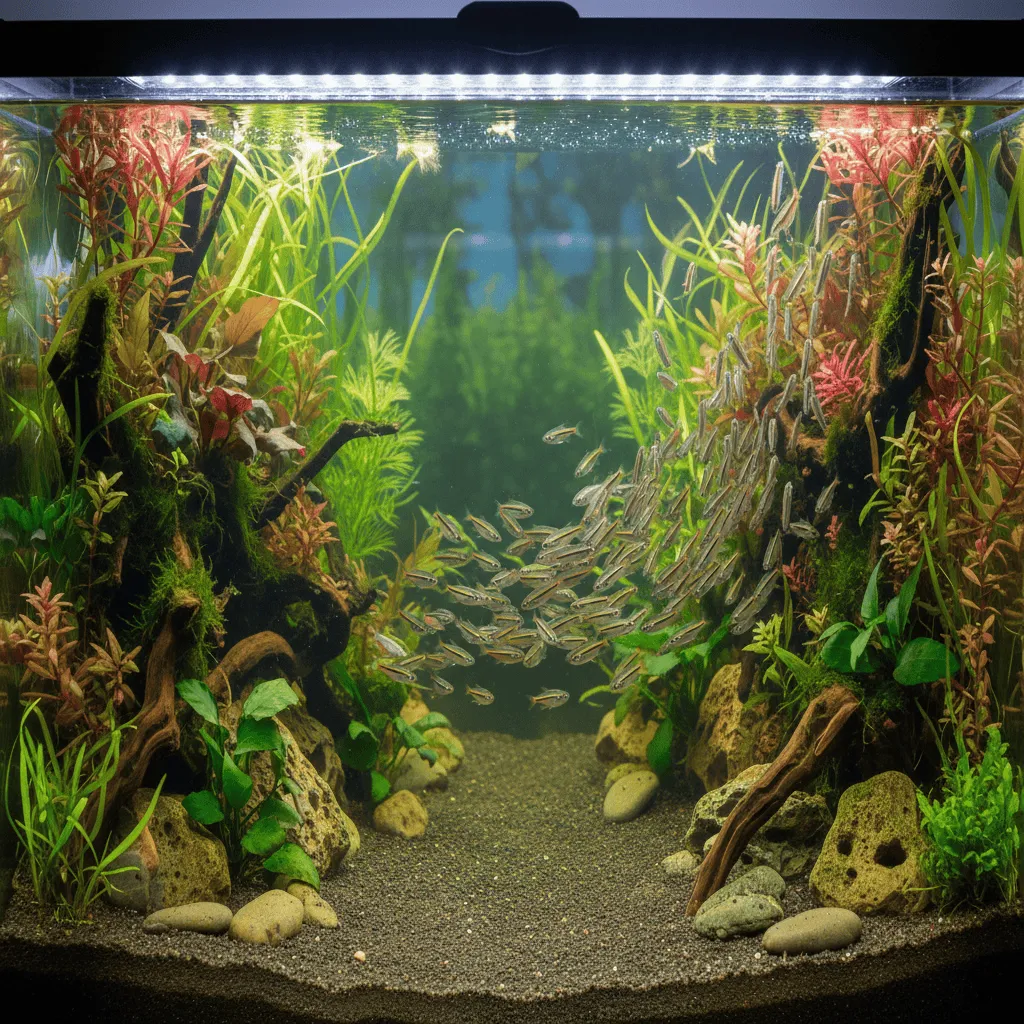
Zebra danios are not picky about decor, but a thoughtful layout improves their health and appearance.
Substrate:
- Fine gravel or sand
- Natural tones (brown/black) look best
Hardscape:
- Rounded river stones
- Driftwood or root-like branches
- Occasional caves or rock piles
Plants (recommended):
- Background:
- Vallisneria, Amazon Swords, Hygrophila
- Mid/foreground:
- Cryptocoryne, Java Fern, Anubias
- Floating plants:
- Frogbit, Salvinia, Water Lettuce
Layout idea:
- Plants and wood around the sides and back
- Open central swimming are
4. Water Quality for Zebra Danios
Zebra danios are hardy, but consistent water quality still matters for longevity and disease prevention.
Recommended Parameters
- Temperature: 68–78°F (20–26°C)
- pH: 6.5–7.5
- GH (General Hardness): 5–19 dGH
- KH (Carbonate Hardness): 3–12 dKH
They adapt to a variety of conditions, but avoid extreme soft/acidic or very hard/alkaline water unless gradually acclimated.
Nitrogen Cycle Targets
- Ammonia: 0 ppm
- Nitrite: 0 ppm
- Nitrate: ideally < 20 ppm (always under 40 ppm)
Perform:
- 25–40% weekly water changes
- Regular siphoning of detritus from the substrate
Water Testing: Why It’s Essential
Even hardy fish benefit from monitoring:
- Track cycling in new tanks
- Detect overstocking or filter problems early
- Prevent long-term nitrate buildup
Use liquid test kits for:
- Ammonia, Nitrite, Nitrate, pH
- Optional GH/KH for fine-tuning livebearer or biotope setups
Affiliate Tip (Test Kits):
Recommend a “Freshwater Master Test Kit” and GH/KH kit from leading brands (e.g., API, JBL). These are high-value affiliate products with strong search demand.
5. Zebra Danio Diet & Feeding
Food Type
Zebra danios are omnivores and opportunistic feeders:
In the wild, they eat:
- Small insects and larvae
- Crustaceans
- Zooplankton
- Algae and plant matter
In captivity, they thrive on:
- Quality dry foods
- Occasional live/frozen treats
Staple Foods
- High-quality tropical flakes (crushed small)
- Small micro pellets
- Slow-sinking granules
Ingredients to look for:
- Whole fish or shrimp meal as first ingredient
- Color-enhancing components (krill, spirulina)
- Added vitamins and minerals
Live & Frozen Foods (Highly Recommended)
- Daphnia
- Brine shrimp
- Bloodworms (in moderation)
- Cyclops, mosquito larvae
These enhance:
- Color
- Activity
- Breeding condition
Feeding Frequency & Amount
- Adults:
- Feed 1–2 times per day
- Only what they can eat in 1–2 minutes
- Juveniles:
- 2–3 small meals per day
Because they’re very active, they can burn calories quickly, but still avoid overfeeding to prevent water quality problems.
Best Food Brands (for Affiliate Links)
Good options to recommend:
- Hikari – Micro Pellets, Tropical Fancy Guppy
- Tetra – TetraMin flakes, Tetra Color
- Fluval Bug Bites – small fish formula
- Omega One – freshwater flakes and mini pellets
You can create a “Best Food for Zebra Danios” section with product boxes and affiliate links.
6. Temperament & Tank Mates
Temperament
Zebra danios are:
- Generally peaceful, but extremely active
- Schooling fish – must be kept in groups (min. 6, preferably 10+)
- Can show mild fin-nipping or chasing behavior when:
- Kept in too small a group
- In too small a tank
They spend most of their time in the upper and middle water column.
Suitable Tank Mates
Look for similarly sized, peaceful fish that can tolerate their high activity:
- Other small danios (e.g., Pearl Danio, Celestial Pearl Danio with caution)
- Tetras (Black Neon, Glowlight, Rummy-nose, Ember)
- Rasboras (Harlequin, Lambchop, Scissortail)
- Corydoras catfish
- Otocinclus catfish
- Dwarf rainbowfish (e.g., Threadfin, Small Melanotaenia)
- Livebearers (guppies, platies) if they tolerate the slightly cooler range
Unsuitable Tank Mates
Avoid:
- Very slow, long-finned fish that may be stressed by chasing:
- Fancy guppies (show strains), Betta splendens in small tanks, long-finned angelfish
- Large or aggressive fish that may see danios as food:
- Big cichlids (Oscars, Jack Dempsey, Green Terror)
- Large predatory catfish
If you want to keep them with bettas or long-finned species, use a larger tank and keep a big enough group of danios so they focus on each other, not on nipping.
7. Breeding Zebra Danios
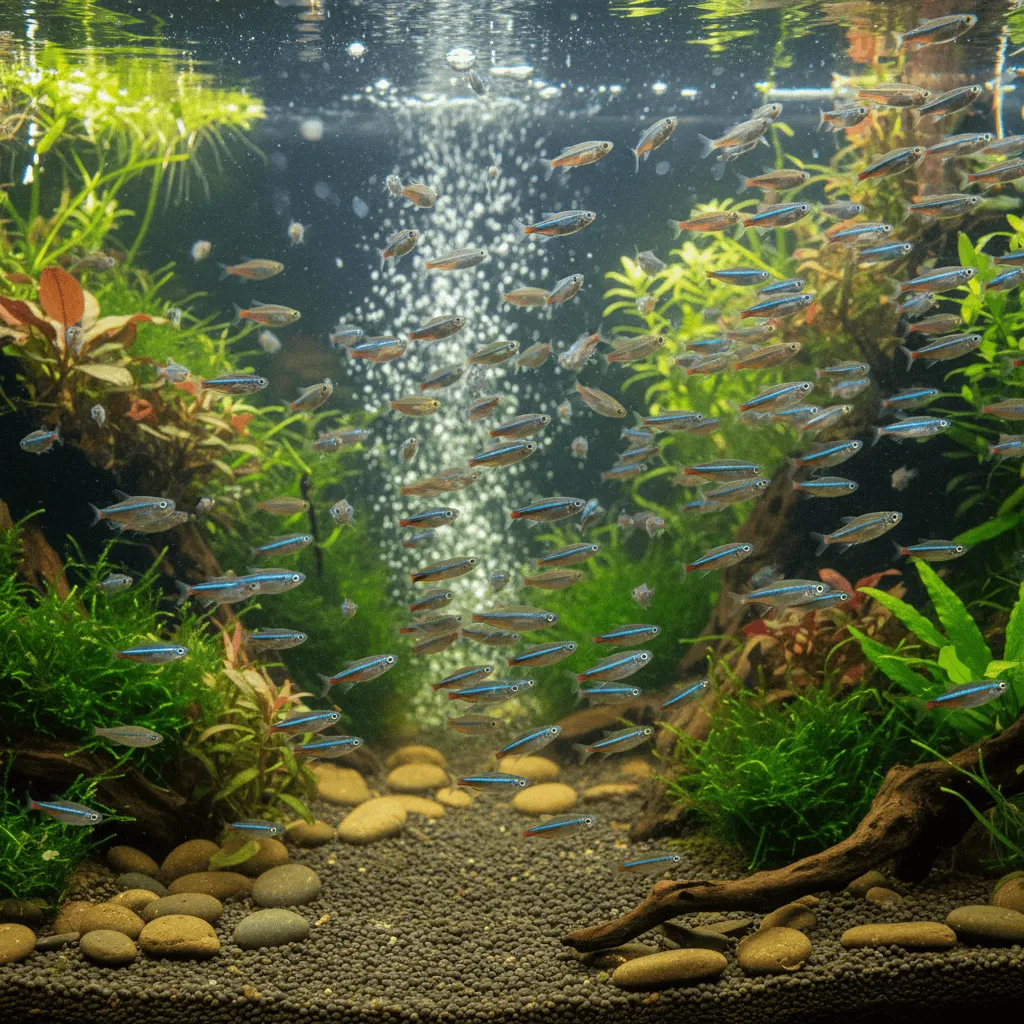
Zebra danios are egg scatterers and fairly easy to breed, which is why they’re used extensively in scientific research.
Sex Differences (Male vs Female)
Males:
- Slightly slimmer, more torpedo-shaped
- Often more intensely colored
Females:
- Slightly deeper/broader body
- Fuller belly when filled with eggs
Breeding Tank Requirements
For controlled breeding:
- Tank size: 5–10 gallons (20–40 liters)
- Substrate:
- Marbles, mesh, or breeding grid on bottom
- This allows eggs to fall out of reach of the parents
- Water:
- Temperature: ~75–78°F (24–26°C)
- pH: 6.5–7.2
- Soft to moderately soft water preferred
Add:
- Fine-leaved plants or spawning mops
- Gentle sponge filter
Spawning Process
- Condition breeders for 1–2 weeks with live/frozen foods.
- Set up breeding tank in a quiet area.
- Add 1–2 females and 2–3 males in the evening.
- Spawning typically occurs at dawn:
- Males chase females
- Eggs are scattered and fertilized in mid-water, then fall to bottom
- After spawning (often hundreds of eggs), remove adults to prevent them from eating the eggs.
Care of Eggs & Fry
- Eggs hatch in about 2–3 days, depending on temperature.
- Fry become free-swimming after another 1–2 days.
First Foods:
- Infusoria (microscopic organisms)
- Commercial liquid fry foods
After a few days:
- Microworms
- Newly hatched brine shrimp (excellent for growth)
- Crushed flakes
Maintain:
- Very gentle filtration (sponge filter)
- Frequent small water changes
Zebra danio fry are small and delicate at first but grow quickly with good food and clean water.
8. Zebra Danio Health & Disease
Zebra danios are hardy but not immune to disease. Good water quality and quarantine practices are your best prevention tools.
Common Diseases
- Ich (White Spot Disease)
- Small white cysts on body and fins
- Fish may scratch against objects
- Fin Rot
- Frayed, ragged fins
- Bacterial infection, often due to poor water quality
- Fungal Infections
- Cotton-like white/gray patches on skin or fins
- Columnaris (Bacterial)
- White/grayish patches, often around mouth, dorsal area
- Mycobacteriosis (“Fish TB”) – more common in danios than some other fish
- Chronic, slow-developing disease
- Symptoms: weight loss, spinal deformities, skin lesions
- Very difficult to treat; prevention via hygiene and not mixing with sick stocks is key
Early Symptoms to Watch For
- Clamped fins
- Lethargy (less active than usual)
- Loss of appetite
- Abnormal swimming (tilting, spiraling)
- Visible spots, patches, or lesions
- Sudden isolation from the group
Treatment Recommendations
Note: Always identify the disease as accurately as possible and follow medication instructions. Remove carbon from filters during treatment.
1. Quarantine & Isolation
- Move affected fish to a hospital tank if possible.
- This prevents spread and allows focused treatment.
2. Improve Water Conditions
- Test water: ammonia, nitrite, nitrate, pH.
- Correct any issues with partial water changes and better filtration.
3. Disease-Specific Treatments (Examples)
- Ich:
- Slowly raise temperature to ~78°F (25–26°C)
- Use commercial Ich medications (malachite green, formalin-based or safer alternatives)
- Fin Rot / Bacterial Infections:
- Broad-spectrum antibacterial medications
- Mild cases may improve with pristine water and aquarium salt (at proper dosing)
- Fungal Infections:
- Antifungal treatments or combined bacterial/fungal medications
- Mycobacteriosis (“Fish TB”):
- No reliable hobbyist-level treatment
- Infected fish should be humanely euthanized to prevent spread
- Strict hygiene: never use aquarium equipment in multiple tanks without disinfection
Affiliate Tip (Medications):
Link to Ich treatments, antibacterial/fungal meds, and aquarium salt (API, Seachem, etc.). High buyer intent and CPC.
This information is for educational purposes and does not replace veterinary diagnosis.
9. Where to Buy Zebra Danios
Price Range
Zebra danios are widely available and usually very inexpensive:
- Often sold individually or in groups (e.g., 5, 10, 20)
- Standard zebra danios and long-fin variants are usually cheap
- Specialty or GloFish® danios may be moderately more expensive
Exact prices depend on your region and the variety.
Trusted Sources
Local Fish Stores (LFS):
- Check for:
- Clean tanks and active fish
- No visible disease or dead fish in the display
- Schooling behavior (danios should not be listless or isolated)
Fish Farms / Breeders:
- Better for bulk purchases or specific morphs
- Can provide hardier, well-acclimated stock
Online Stores:
- Look for:
- Good reviews and ratings
- Live-arrival guarantees
- Proper insulated packaging and shipping times
When choosing zebra danios:
- Avoid individuals with curved spines, sunken bellies, or ragged fins
- Look for bright colors, active swimming, and schooling behavior
You can promote online retailers offering “Zebra Danio Starter Packs” or “School of 10 Zebra Danios” via affiliate programs.
10. Summary & Final Verdict
Are Zebra Danios Good for Beginners?
Yes – they are among the best beginner fish you can keep.
Pros:
- Extremely hardy and adaptable
- Very active and entertaining
- Peaceful community fish when kept in proper numbers
- Easy to feed and not picky eaters
- Relatively easy to breed (for those who want to try)
Considerations:
- Must be kept in schools of 6+ (10+ is better)
- Need a tank long enough for swimming (20 gallons recommended for bigger groups)
- High activity can stress very slow or delicate tank mates
If you want a forgiving, active schooling fish that looks great in almost any community tank, Zebra Danios are one of the top choices for both beginners and experienced aquarists.