With their stately, graceful presence and intelligent personalities, Freshwater Angelfish are one of the most iconic and beloved fish in the aquarium hobby. Their disc-shaped bodies and long, elegant fins give them a majestic appearance that few other fish can match. For many, they are the very definition of a “centerpiece” fish.
This ultimate guide will cover everything you need to know about Angelfish care, from selecting the right tank and tank mates to breeding and ensuring their long-term health
1. Introduction & Quick Facts
Common Name: (Freshwater) Angelfish
Most Common Species in Aquariums: Pterophyllum scalare
Other Species: P. altum (Altum Angelfish), P. leopoldi (Leopold’s Angelfish – rarer)
Angelfish Quick Stats
| Angelfish Quick Facts | |
|---|---|
| Scientific Name | Pterophyllum scalare (common freshwater angelfish) |
| Care Level | Moderate (suitable for informed beginners and intermediate keepers) |
| Temperament | Semi-aggressive (peaceful when young, territorial as adults) |
| Size at Maturity | Body length ~6 in (15 cm), total height up to 8–10 in (20–25 cm) with fins |
| Minimum Tank Size | 30 gallons / 110 liters (for a single pair), 55+ gallons / 200+ liters for a group |
| Water Temperature | 76–82°F (24–28°C), ideal 78–80°F (25–27°C) |
| pH Range | 6.5–7.5 (slightly acidic to neutral) |
| Water Hardness | 3–10 dGH (soft to moderately hard) |
| Lifespan | 8–10 years with good care |
| Diet | Omnivore (carnivorous lean – insects, small invertebrates, pellets) |
| Breeding | Open substrate/leaf spawners, form monogamous pairs |
2. Comprehensive Overview
Origin & Natural Habitat
Freshwater angelfish come from tropical South America, especially:
- Amazon River basin
- Orinoco River system
- Slow-moving tributaries and floodplains in Brazil, Peru, Colombia, Venezuela, and Guyana
Typical wild habitats:
- Calm, slow-flowing waters: backwaters, flooded forests, oxbow lakes
- Dense submerged roots, branches, and vegetation
- Soft, warm, slightly acidic water
- Leaf litter and dim lighting from tree canopy above
Their tall, laterally compressed bodies help them maneuver among roots and stems in flooded forests.
Appearance & Color Variations
Body Shape & Fins:
- Tall, disc-shaped body
- Long dorsal and anal fins that extend vertically
- Long trailing ventral (pelvic) fins, like streamers
- Triangular outline when viewed from the side
Size:
- Body length up to ~6 in (15 cm)
- Total height up to 8–10 in (20–25 cm) including fins
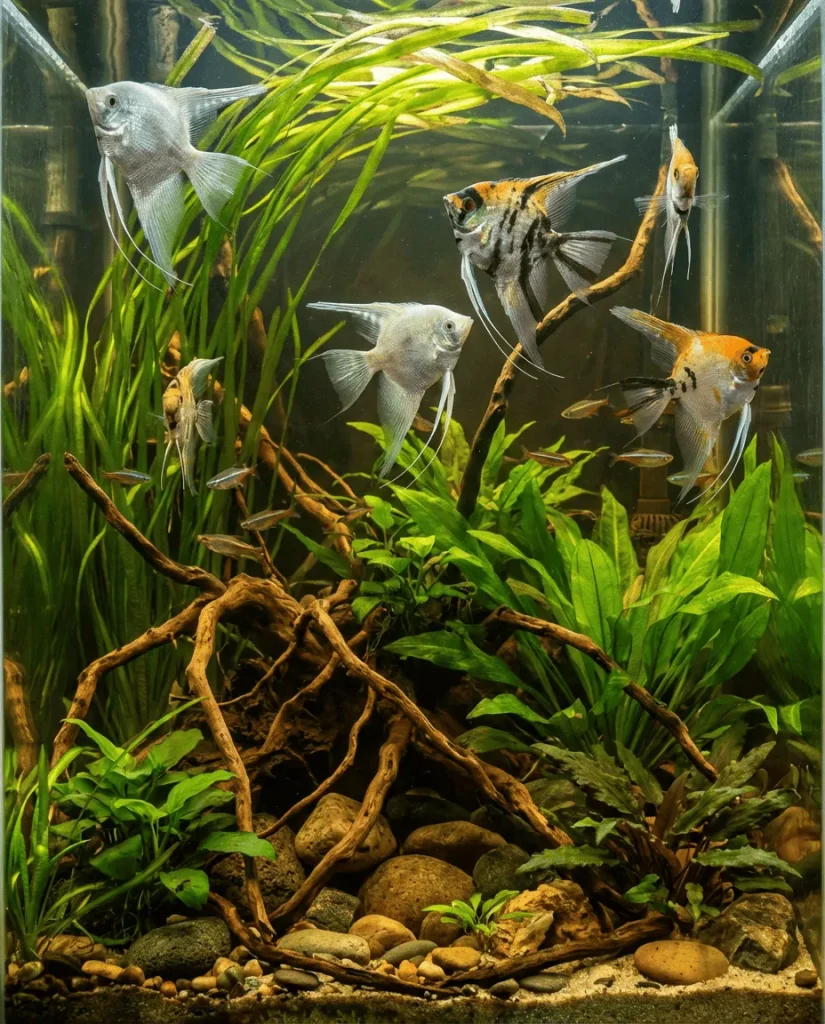
Popular Color & Fin Morphs (Pterophyllum scalare)
Over decades of selective breeding, many angelfish varieties have been developed:
- Silver / Wild-Type Angelfish
- Silver base with vertical black stripes (3–4 bars)
- Marble Angelfish
- Irregular black, silver, and sometimes gold patches
- Gold Angelfish
- Solid golden/yellow body, may have red eyes
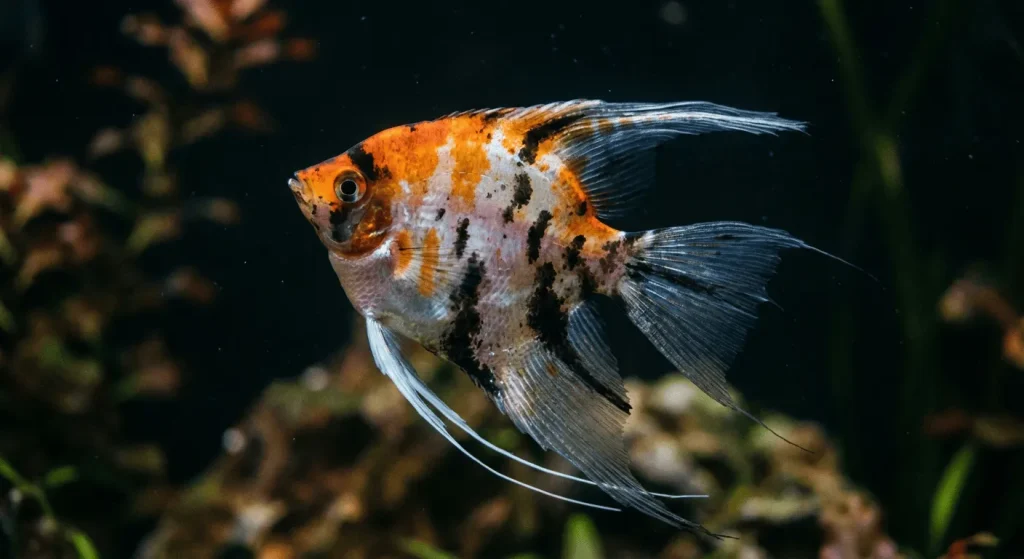
- Koi Angelfish
- White/gold body with orange/red patches on the head and back
- Black / Double Black Angelfish
- Mostly or fully black body and fins
- Zebra Angelfish
- More vertical stripes than the standard silver
- Veil Tail Angelfish
- Extra-long flowing fins; also available in most color patterns
- Pearlscale Angelfish
- Iridescent “bumpy” scales reflecting light like pearls
3. Angelfish Tank Requirements & Setup
Angelfish are cichlids and need a properly sized, tall tank with stable water conditions.
Tank Size
Because of their height and territorial nature:
- Single angelfish:
- 20–30 gallons (75–110 liters) minimum
- Tall tank (at least 18 in / 45 cm high) preferred
- Mated pair:
- 30 gallons (110 liters) minimum
- Group (4–6 angelfish):
- 55+ gallons (200+ liters)
- Again, tall tanks are better than low, shallow ones
For best results, keep a single angelfish or a compatible mated pair, or a larger group (6+) in a big tank. 2–3 unpaired angelfish often leads to bullying.
Filtration
Angelfish prefer:
- Clean, well-filtered water
- Gentle to moderate flow (not blasting current)
Recommended filters:
- Canister Filter
- Excellent for 55+ gallon tanks
- Large media capacity; great for planted angelfish aquariums
- Hang-On-Back (HOB) Filter
- Suitable for 30–55 gallon tanks
- Choose a quiet, reliable model with adjustable flow
- Sponge Filter
- Useful as supplemental filtration or in breeding tanks
Flow:
- Moderate flow is ideal; too strong a current can stress angelfish and damage their fins. Aim the outflow toward glass or decor to diffuse.
Affiliate Tip (Filters):
Highlight high-quality canister filters (e.g., Fluval, Eheim) and large HOB filters (e.g., AquaClear, Seachem Tidal) as “best filters for angelfish and planted cichlid tanks.”
Temperature & Heater
Angelfish are tropical and require warm, stable temperatures:
- Ideal: 78–80°F (25–27°C)
- Range: 76–82°F (24–28°C)
Use:
- An adjustable heater with thermostat
- Roughly 3–5W per gallon (e.g., 150–200W for a 55-gallon)
- Reliable brands with overheat protection and shatter-resistant design
Lighting
Angelfish come from dim, forested waters, but in aquariums:
- Moderate lighting is perfect, especially if you keep plants
- Too bright, bare tanks can stress them – use plants, driftwood, or floating plants to create shaded areas
Use a full-spectrum LED aquarium light:
- 6–8 hours/day for low-tech set-ups
- 8–10 hours/day in planted tanks (with CO₂/ferts as needed)
Decor: Rocks, Wood, Caves & Plants
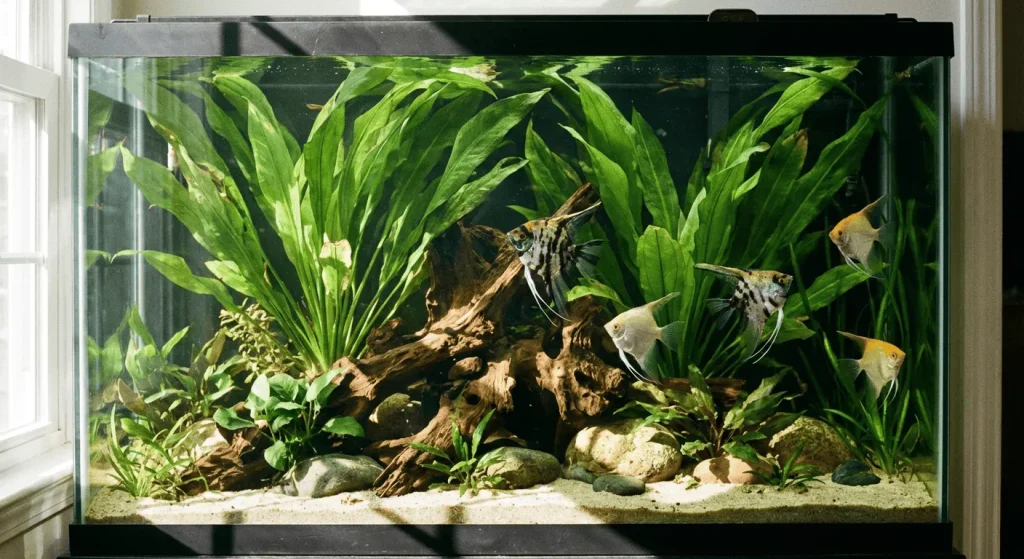
Aim for a soft Amazon-style aquascape:
Substrate:
- Fine sand or smooth gravel
- Dark substrates show off angelfish colors nicely
Hardscape:
- Driftwood branches and roots
- Smooth rocks (no sharp edges)
- Vertical decor (tall wood or slate) mimics their natural environment
Plants:
Angelfish thrive in planted aquariums:
- Background:
- Amazon Swords (classic choice)
- Vallisneria
- Hygrophila, Ludwigia
- Mid/foreground:
- Cryptocoryne
- Java Fern, Anubias attached to wood/rocks
- Floating plants:
- Frogbit, Amazon Frogbit, Water Lettuce
- Provide shade and security
4. Water Quality for Angelfish
Stable, clean water is critical, especially for adult and breeding angelfish.
Recommended Parameters
- Temperature: 76–82°F (24–28°C), ideal 78–80°F
- pH: 6.5–7.5 (slightly acidic to neutral)
- GH (General Hardness): 3–10 dGH
- KH (Carbonate Hardness): 2–6 dKH
Captive-bred angelfish are more tolerant of varied conditions than wild-caught specimens, but sudden swings are still harmful.
Nitrogen Compounds
- Ammonia (NH₃): 0 ppm
- Nitrite (NO₂): 0 ppm
- Nitrate (NO₃): ideally < 20 ppm (max 40 ppm)
Perform:
- 25–40% weekly water changes (more with heavy stocking)
- Regular gravel vacuuming to remove waste
Water Testing
Use liquid test kits (more accurate than strips) to measure:
- Ammonia, Nitrite, Nitrate
- pH regularly
- GH/KH if you keep delicate varieties or breed them
Affiliate Tip (Test Kits):
Recommend a “Freshwater Master Test Kit” plus a GH/KH kit from trusted brands. Emphasize their importance in maintaining proper angelfish water parameters.
5. Angelfish Diet & Feeding
Food Type (Omnivorous with Carnivorous Lean)
In the wild, angelfish eat:
- Insect larvae
- Small crustaceans
- Worms
- Occasionally small fish and fry
In aquariums, they thrive on:
- High-quality prepared foods
- Regular frozen/live protein sources
Staple Foods
- Sinking or slow-sinking cichlid pellets
- High-quality tropical flakes
- Granules formulated for medium-sized cichlids
Look for:
- Whole fish/shrimp as main proteins
- Balanced vitamins and minerals
Frozen & Live Foods (Highly Beneficial)
- Frozen or live brine shrimp
- Bloodworms (use moderately; can be rich)
- Daphnia
- Mysis shrimp
These foods:
- Enhance color
- Help condition adults for breeding
- Stimulate natural hunting behavior
Feeding Frequency & Amount
- Adults:
- 1–2 feedings per day
- Only what they can consume in 2–3 minutes
- Juveniles / Growing Fish:
- 2–3 smaller meals per day
Avoid overfeeding – angelfish are prone to obesity and water quality issues in overfed tanks.
Best Food Brands for Angelfish (Affiliate-Friendly)
Consider recommending:
- Hikari Cichlid Bio-Gold / Hikari Vibra Bites
- Fluval Bug Bites (Cichlid or medium fish formula)
- Omega One Cichlid Pellets
- New Life Spectrum Cichlid Formula
You can create a short comparison or “Best Angelfish Food” section linking to each product.
6. Angelfish Temperament & Tank Mates
Temperament
Angelfish are:
- Generally calm and graceful
- Semi-aggressive as they mature, especially when pairing and spawning
- Territorial toward other angelfish or similar-shaped fish
Behavior notes:
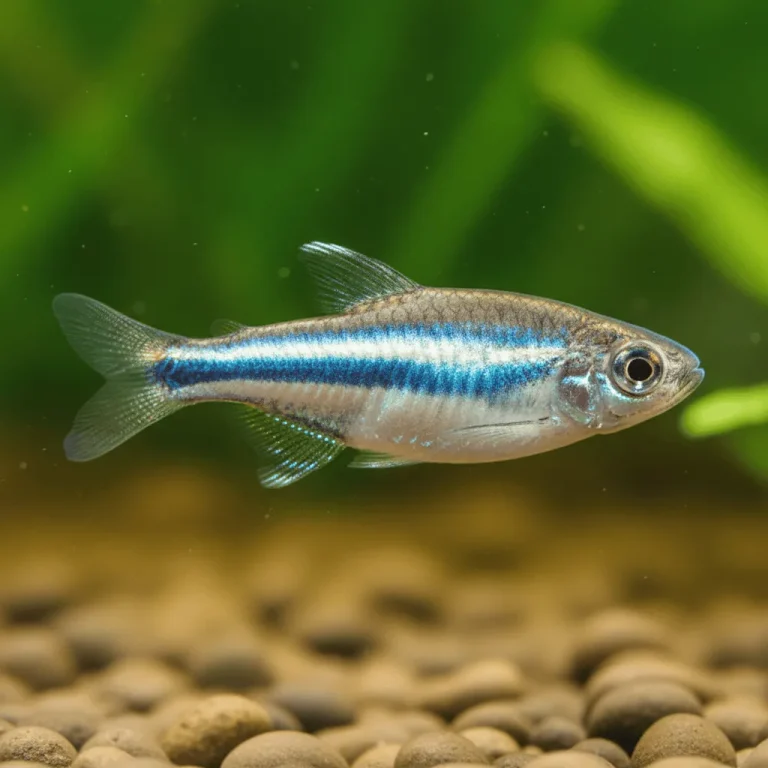
- They may chase or nip smaller tank mates, especially tiny fish that fit in their mouth (like neon tetras).
- During breeding, they become highly territorial and protective of their eggs/fry.
Suitable Tank Mates
Look for:
- Non-nippy
- Similar-sized or slightly smaller fish
- Peaceful to semi-aggressive temperament
- Preferably mid to upper-level swimmers that won’t harass angelfish fins
Good options include:
- Medium tetras (Rummy-nose, Black Skirt, Lemon, Bleeding Heart – avoid very tiny tetras with large adult angels)
- Rainbowfish (smaller species, like Dwarf Neon Rainbowfish)
- Corydoras catfish
- Bristlenose Plecos
- Gouramis (peaceful species like Pearl or Honey Gourami; monitor compatibility)
- Larger rasboras (Harlequin, Espei, Scissortail)
Unsuitable Tank Mates
Avoid:
- Very small fish that may be eaten:
- Neon tetras, ember tetras, small rasboras when kept with full-grown angels
- Aggressive fin-nippers:
- Tiger Barbs
- Serpae Tetras (in small groups)
- Large, aggressive cichlids:
- Oscars
- Convicts
- Green Terror
- Very slow, delicate long-finned fish (in smaller tanks):
- Fancy Bettas
- Very fancy long-finned guppies
In large tanks, some of these combinations can work with careful planning, but they’re risky for most beginners.
7. Breeding Angelfish
Angelfish are pair-bonding, open substrate spawners. Breeding them is rewarding but requires planning.
Sex Differences (Male vs Female)
Sexing angelfish is subtle and not 100% reliable until they form pairs:
Males (often):
- Slightly more angular forehead (nuchal region)
- Sometimes a more extended dorsal/anal fin
- Larger, more robust body in some lines
Females (often):
- Slightly more rounded belly
- Shorter or more rounded dorsal profile
The most reliable way:
- Raise a group (6–8 juveniles), allow pairs to form naturally, then move established pairs to their own breeding tank.
Breeding Tank Requirements
Dedicated breeding setup:
- Tank size: 20–30 gallons (75–110 liters)
- Bare bottom or minimal substrate for easy cleaning
- Gentle filtration (sponge or buffered HOB)
- Temperature: 78–80°F (25–27°C)
- pH: 6.5–7.0
- Soft to moderately soft water
Include:
- Vertical surfaces for spawning:
- Broad-leaf plants
- Vertical slate
- Commercial breeding cones
Spawning & Egg Care
Spawning process:
- Pair cleans a vertical surface.
- Female lays a line of sticky eggs.
- Male follows, fertilizing them.
- This repeats until 100–400+ eggs are laid.
- Parents fan and guard eggs, removing infertile or fungus-covered ones.
Options:
- Leave eggs with parents:
- Good parents can raise multiple batches.
- Risk: first-time parents often eat their eggs/fry, especially if stressed.
- Remove eggs:
- Move the spawning slate/cone to a separate hatching tank.
- Use gentle aeration and methylene blue (where legal) to reduce fungus.
Fry & Juvenile Care
- Eggs hatch in ~2–3 days (depending on temperature).
- Larvae remain attached (wigglers) for ~3–4 days.
- Fry become free-swimming about a week after spawning.
Feeding Fry:
- First foods:
- Newly hatched brine shrimp (BBS) – ideal
- Commercial liquid fry food or powdered fry food
- Feed small amounts 3–4 times per day.
- Perform small, frequent water changes with matched temperature/water chemistry.
8. Angelfish Health & Disease
Angelfish share many common freshwater diseases, plus some cichlid-specific issues.
Common Diseases
- Ich (White Spot Disease)
- Small white spots, flashing/scratching behavior
- Fin Rot
- Ragged fins, bacterial infection often caused by poor water quality
- Fungal Infections
- Cotton-like patches on body/fins
- Hole-in-the-Head Disease (HITH) / Lateral Line Erosion
- Common in cichlids (including angels and discus)
- Pitting around head and sensory line, often linked to poor water, nutritional deficits, or Hexamita parasites
- Internal Parasites (Hexamita, worms)
- Weight loss, white/stringy feces, poor appetite
- Bacterial Infections
- Cloudy eyes, ulcers, red streaks in fins
Early Symptoms
Watch for:
- Clamped fins
- Darkened color or unusual paleness
- Loss of appetite
- Hovering at surface or bottom
- Rapid breathing or gill movement
- Visible spots, lesions, or pits on head
Treatment Recommendations
Important: Always identify the likely cause and follow medication instructions carefully. Remove carbon from filters while medicating.
General Steps:
- Isolate / Quarantine:
- Move sick fish to a hospital tank when possible.
- Improve Water Quality:
- Test ammonia, nitrite, nitrate, pH.
- Correct issues with partial water changes and maintenance.
- Appropriate Medications:
- Ich:
- Gradually raise temperature to ~80°F (26–27°C).
- Use commercial Ich meds (malachite green/formalin, or safer formulations) according to label.
- Fin Rot/Bacterial:
- Broad-spectrum antibacterial medications.
- Mild cases may improve with excellent water and aquarium salt (where appropriate).
- Fungal:
- Dedicated antifungal meds or combined bacterial/fungal treatments.
- HITH / Internal Parasites (Hexamita):
- Improve diet (high-quality, vitamin-rich foods).
- Use metronidazole-based treatments where legal and appropriate.
Affiliate Tip (Medications):
Recommend Ich treatments, broad-spectrum antibiotics, antifungals, and aquarium salt from brands like API, Seachem, etc. These are high-intent purchases often associated with higher CPC.
This section is for informational purposes and does not replace professional veterinary advice.
9. Where to Buy Angelfish
Price Range
Prices vary widely by:
- Size
- Color/fin morph
- Quality and strain
- Species (P. scalare vs. rare P. altum)
Typical ranges (approximate):
- Common scalare juveniles (silver, marble, zebra, gold):
- Low–moderate price per fish
- Veil tail, koi, pearlscale, black angels:
- Moderate price, sometimes sold as premium varieties
- Altum angelfish (P. altum):
- Much more expensive; require specialized care
Exact numbers depend on your country and local market.
Trusted Sources
Local Fish Stores (LFS):
- Pros: see fish in person, choose strong individuals
- Look for:
- Clean tanks
- No dead fish
- Clear eyes, intact fins, good body condition
Breeders / Fish Farms:
- Even better for quality and specific strains
- More likely to have stable genetics, better form, and healthier stock
Online Stores:
- Check:
- Customer reviews and ratings
- Live-arrival guarantee
- Proper insulated packaging and overnight/express shipping
When selecting angelfish:
- Avoid bent spines, clamped fins, faded colors, visible spots or ulcers
- Choose active, alert fish that respond to food and swim upright
You can link to online vendors offering “Assorted Angelfish” or “Premium Koi Angelfish” via your affiliate program.
10. Summary & Final Verdict
Are Angelfish Good for Beginners?
Yes – for prepared beginners and intermediate aquarists.
Why you’ll love them:
- Majestic, iconic appearance
- Graceful swimming and interesting cichlid behavior
- Wide range of color and fin varieties
- Can be centerpiece fish in planted community tanks
- Possibility to breed and raise fry at home
Challenges:
- Need tall, medium-to-large tanks (not for tiny aquariums)
- Semi-aggressive tendencies, especially when breeding
- Will eat very small fish once full-grown
- Sensitive to long-term poor water quality
If you can provide:
- A 30–55+ gallon tall, cycled aquarium
- Stable warm water, good filtration, and regular maintenance
- Appropriately sized tank mates
then freshwater angelfish are an excellent, rewarding choice and can live with you for close to a decade.