In the world of large, predatory fish, one species stands out for its incredible personality, intelligence, and almost dog-like interaction with its owner: the Oscar fish. These are not just fish you watch; they are pets you interact with. An Oscar will learn to recognize you, follow your finger across the glass, and even sulk by lying on its side if it doesn’t get its way.
But this “water dog” personality comes with a big bite and an even bigger appetite. Oscars are large, messy, and highly territorial cichlids that require a massive tank and a dedicated owner. The tiny, cute baby Oscar at the pet store will quickly grow into a foot-long, tank-redecorating behemoth.
This is your definitive guide to Oscar fish care. We will dive deep into what it truly takes to raise one of these aquatic giants, from setting up a “bomb-proof” tank and managing their massive bioload to understanding their complex cichlid temperament and keeping them healthy for over a decade.
1. Introduction & Quick Facts
Oscar Cichlids are South American cichlids that can grow to 12–14 inches (30–35 cm) and live for 10–15+ years. They’re best kept in large, well-filtered tanks with a carefully chosen (or often no) tank mate list.
Quick Facts Table
| Attribute | Details |
|---|---|
| Common Name | Oscar, Oscar Cichlid, Velvet Cichlid |
| Scientific Name | Astronotus ocellatus |
| Origin | Amazon Basin (South America: Brazil, Peru, Colombia) |
| Adult Size | 10–14 in (25–35 cm) in aquariums; up to ~16 in in the wild |
| Lifespan | 10–15+ years (sometimes 20 with excellent care) |
| Care Level | Moderate (easy temperament, but large tank & filtration required) |
| Temperament | Semi-aggressive, territorial, very interactive |
| Minimum Tank Size | 55–75 gallons for one; 125+ gallons for a pair or community |
| Temperature Range | 74–80°F (23–27°C) |
| pH Range | 6.0–7.5 (slightly acidic to neutral) |
| Hardness Range | 5–15 dGH (slightly soft to moderately hard) |
| Tank Level | Mostly mid-water but uses entire tank |
| Diet Type | Omnivore / carnivore-leaning (insects, crustaceans, pellets) |
2. Species Profile & Varieties
2.1 Origin & Natural Habitat
In the wild, the Oscar Cichlid is found in:
- Slow-moving rivers and tributaries of the Amazon Basin, including Peru, Colombia, and Brazil
- Warm, soft, slightly acidic waters
- Areas with submerged branches, roots, and leaf litter
They feed on:
- Small fish
- Insects and larvae
- Crustaceans
- Plant material and detritus
Their natural habitat explains many of their aquarium needs: warm, clean water, complex decor, and a strong appetite.
2.2 Physical Characteristics
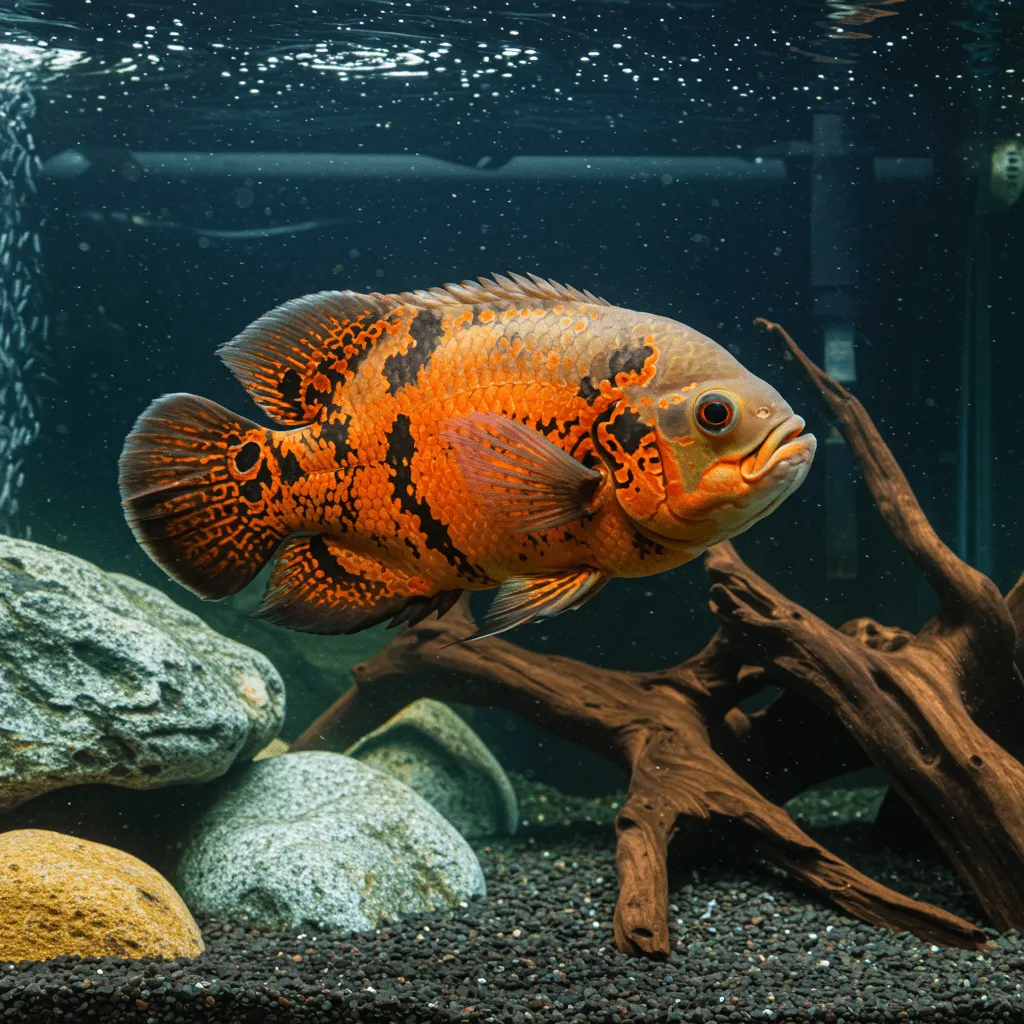
- Deep, oval body with a large head and mouth
- Powerful, undulating movement—can be surprisingly fast when chasing food
- Large eyes that move and track activity outside the tank
- Juveniles often have faint, mottled patterns that intensify with age
2.3 Common Oscar Cichlid Varieties
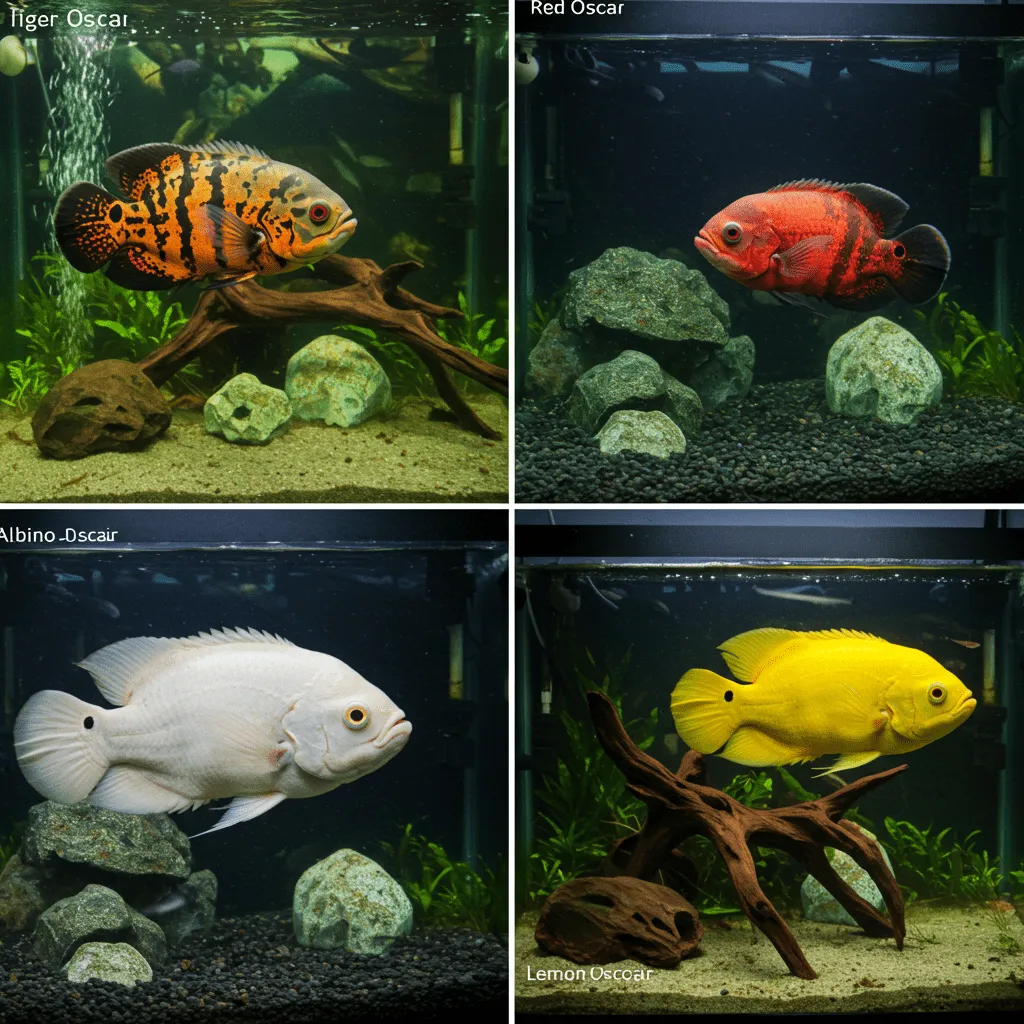
Over years of selective breeding, many color morphs have been developed. All share the same basic care requirements.
| Variety Name | Description |
|---|---|
| Tiger Oscar | Classic black body with orange/red mottled pattern, “tiger-like” spots |
| Red Oscar | Dark body with larger, solid red/orange areas |
| Albino Oscar | White/cream body with red/orange pattern; red or pinkish eyes |
| Lutino Oscar | Similar to albino but often with more yellow/gold tones |
| Lemon Oscar | Bright yellow/golden coloration, sometimes mixed with white |
| Wild-Type Oscar | More natural brown/green background with orange eye spots |
| Veil Tail Oscar | Long-finned variety; extended dorsal, anal, and caudal fins |
3. Tank Requirements & Setup
3.1 Minimum Tank Size
This is where many Oscar keepers go wrong. Juvenile Oscars look small and cute, but they grow quickly.
- Single adult Oscar:
- 55 gallons is an absolute minimum, but 75 gallons is strongly recommended.
- Two Oscars (pair or companions):
- 125–150 gallons minimum.
- Oscar community tank (Oscars + other large fish):
- 150–180+ gallons with robust filtration.
If you can’t realistically provide at least a 75-gallon tank for an adult Oscar, it’s best to choose a smaller cichlid species.
3.2 Filtration & Water Movement
Oscars are messy eaters and produce a lot of waste:
- Use overrated filtration – aim for at least 6–10x tank volume per hour of turnover.
- Best options:
- Large canister filters (often 2 units on bigger tanks)
- High-capacity HOB filters combined with internal filters/sponge filters
Water flow:
- Moderate; Oscars come from slow-moving waters, but strong filtration output can be diffused with spray bars and baffles.
Add extra aeration if needed (air stones, powerheads pointed at the surface).
3.3 Substrate & Decor
Oscars love to dig and redecorate:
- Substrate:
- Sand or smooth fine gravel is ideal.
- Avoid sharp or very rough substrates (can damage gills and skin).
Decor:
- Heavy driftwood
- Large rocks (placed securely to avoid being knocked over)
- A few sturdy ornaments
They will:
- Uproot plants
- Move decorations
- Dig pits
If you keep plants at all, use:
- Tough, hardy species (Anubias, Java Fern) attached to wood/rocks
- Floating plants for shade
3.4 Lighting
Oscars do fine with standard aquarium lighting:
- Medium intensity is sufficient
- Too-bright light can stress them; provide shadows with driftwood and caves
- A regular day/night cycle of 8–10 hours of light is ideal
3.5 Lids & Jumping
Oscars are powerful fish:
- Use a tight-fitting lid or canopy—they can jump or ram the lid when startled.
- Ensure there are no large gaps where they can escape or get injured.
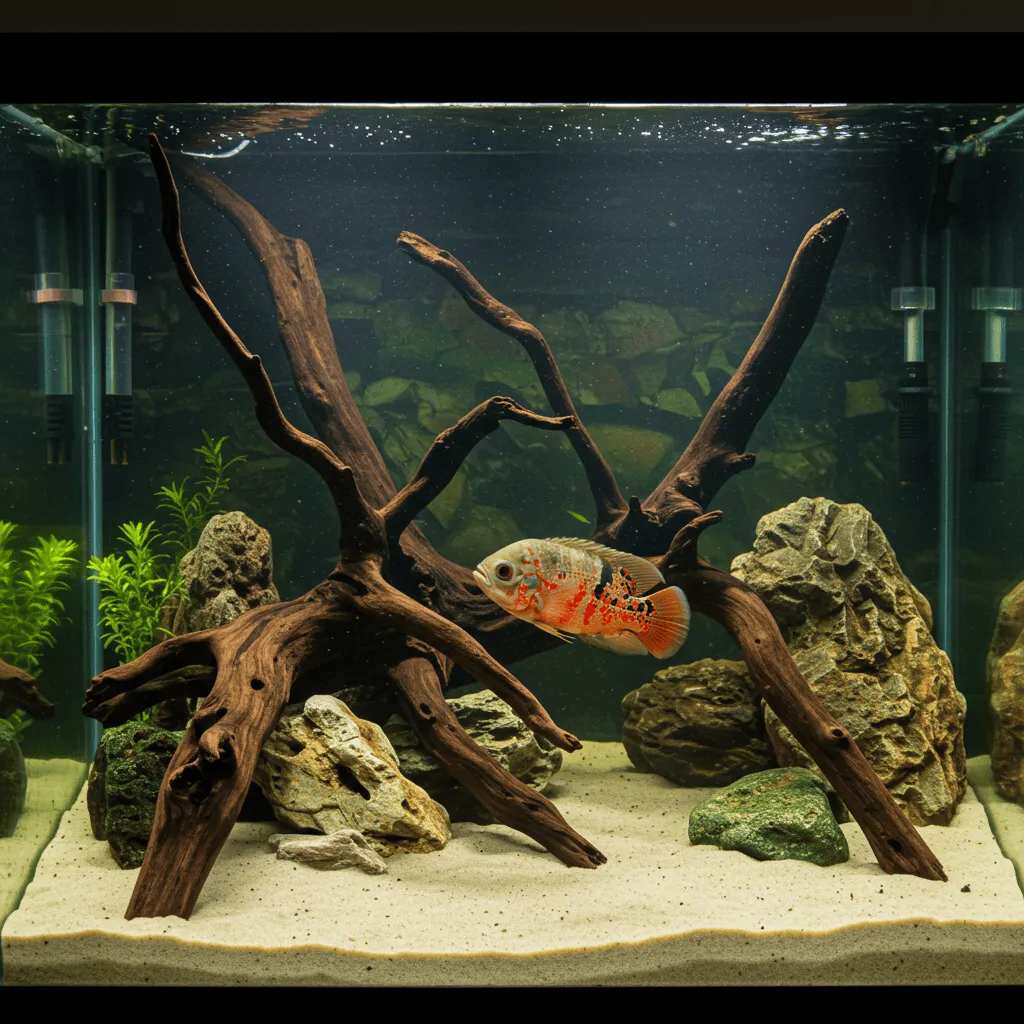
3.6 Aquascape Example
For a single Oscar:
- 75-gallon tank
- Sand substrate
- Large central driftwood piece + scattered rocks
- Few attached plants (Anubias/Java Fern)
- Two large canister filters with spray bars
- LED light with dimmer/timer
4. Water Parameters & Maintenance Schedule
4.1 Ideal Water Parameters
| Parameter | Recommended Range |
|---|---|
| Temperature | 74–80°F (23–27°C), ideal around 76–78°F |
| pH | 6.0–7.5 |
| GH (Hardness) | 5–15 dGH |
| Ammonia | 0 ppm |
| Nitrite | 0 ppm |
| Nitrate | Ideally < 20 ppm (always < 40 ppm) |
Oscars can adapt to a range of conditions as long as:
- The tank is cycled
- Parameters are stable
- Water quality is kept high
4.2 Testing & Monitoring
Use reliable liquid test kits to check:
- Ammonia
- Nitrite
- Nitrate
- pH
Test at least:
- Weekly in established tanks
- More often (2–3x per week) in new setups or after big changes
4.3 Water Changes
As large, messy fish, Oscars require:
- 25–50% water changes every week (or split into 2 smaller changes per week)
- Vacuum the substrate thoroughly to remove waste and leftover food
In heavily stocked tanks, aim closer to 40–50% weekly.
4.4 Filter Maintenance
- Rinse filter media in tank water (never tap water) every 2–4 weeks
- Avoid cleaning all media at once—alternate sides of a canister or different filters to preserve beneficial bacteria
- Replace mechanical media (floss) regularly but keep bio-media long-term
Example Weekly Schedule
| Day | Task |
|---|---|
| Mon | Check fish, quick parameter test (pH, temperature) |
| Wed | 30–40% water change, siphon substrate, clean glass |
| Sat | Inspect filters, rinse pre-filters/sponges if needed |
| Sun | Observe behavior, feeding response, physical condition |
5. Diet, Feeding Schedule & Nutrition Tips
In the wild, Oscar Cichlids eat a mix of:
- Insects
- Worms
- Crustaceans
- Smaller fish
- Plant and fruit material that falls into the water
In the aquarium, the best diet is high-quality prepared foods, with occasional frozen and fresh supplements.
5.1 Staple Foods
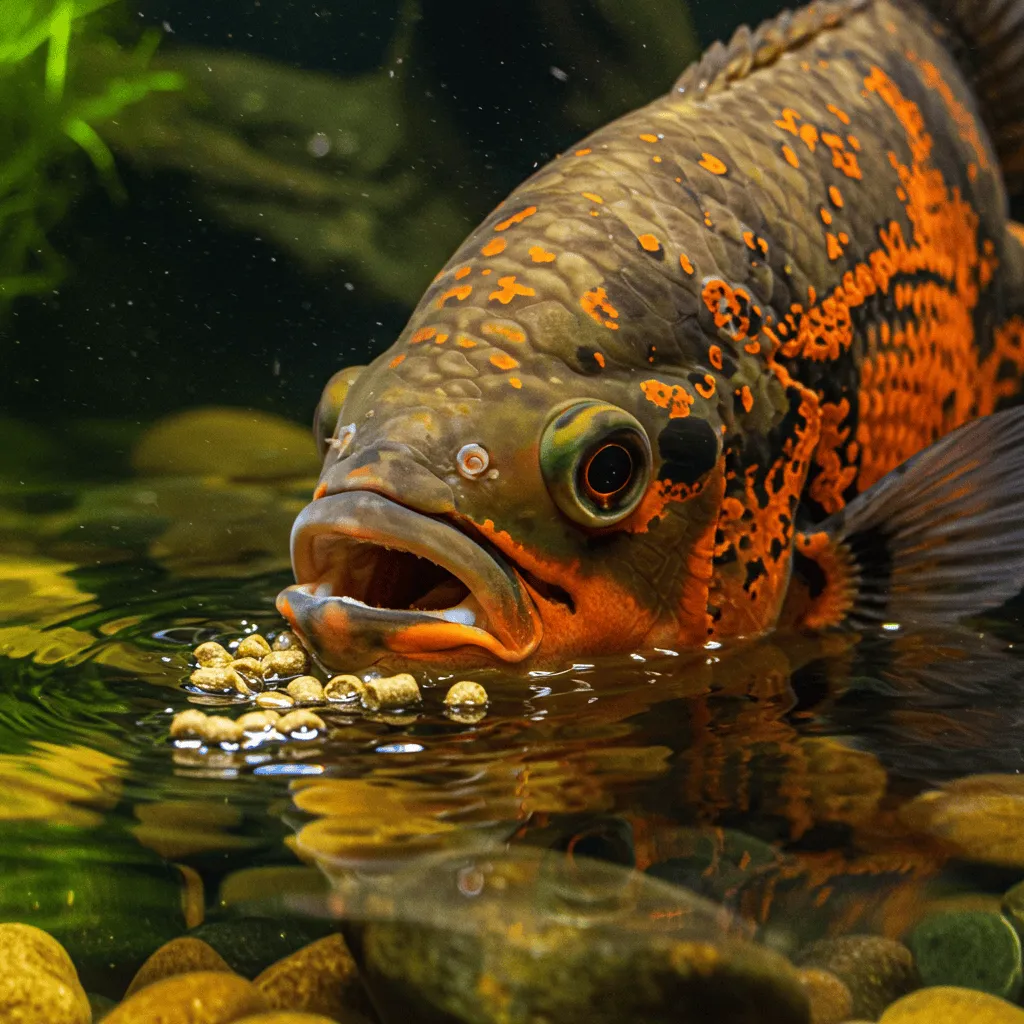
- High-quality cichlid pellets (primary diet)
- Choose medium/large floating or slow-sinking pellets suitable for big cichlids
- Look for whole fish, shrimp, or krill as main ingredients
- Good brands (for affiliate links):
- Hikari Cichlid Gold / Bio-Gold+
- Northfin Cichlid Formula
- New Life Spectrum (NLS) Cichlid formulas
- Fluval Bug Bites for large cichlids
5.2 Treats & Supplemental Foods
2–3 times per week, offer:
- Frozen (or occasional live, from safe sources):
- Bloodworms (for juveniles)
- Krill
- Shrimp
- Silversides (small fish—use sparingly)
- Fresh foods:
- Earthworms (pesticide-free)
- Pieces of shrimp or fish fillet (unseasoned)
Vegetable matter:
- Blanched peas (shelled)
- Bits of zucchini or spinach
These help with digestion and mimic the occasional plant material/wild diet variety.
5.3 Avoid Feeder Fish
Many people feed Oscars “feeder goldfish” or rosy reds. This is not recommended because:
- Feeder fish often carry parasites and diseases
- Goldfish contain thiaminase, which can cause vitamin B1 deficiency when fed often
- It encourages aggressive feeding behavior and is unnecessary for health
Stick to high-quality pellets and controlled frozen foods instead.
5.4 Feeding Frequency
- Juvenile Oscars (under ~6 inches):
- 2–3 small meals per day
- Adults:
- 1–2 meals per day
Feed only what they can completely eat in 2–3 minutes.
Oscars are prone to obesity and water pollution from overfeeding.
5.5 Nutrition Tips
- Vary the diet to prevent boredom and nutritional gaps.
- Don’t overdo very fatty or rich foods (like beef heart or fatty meats).
- Observe stool:
- Normal = solid, dark
- Long, stringy white = possible parasites or digestive issues.
6. Temperament & Tank Mates
6.1 Oscar Cichlid Temperament
Oscars are:
- Semi-aggressive, especially as adults
- Territorial, particularly in smaller tanks
- Very intelligent and interactive—they learn to recognize their owners
- Capable of bonding with keepers, following your hand, and begging for food
They will:
- Rearrange decor
- Dig and sometimes uproot plants
- Chase fish they perceive as food or rivals
6.2 Suitable Tank Mates
Choosing tank mates for an Oscar Cichlid can be tricky. Good options are:
- Similar-sized or larger, robust fish that can hold their own:
- Other large cichlids (Severum, some Earth Eaters, Jack Dempsey) in appropriately large tanks
- Large Silver Dollars (group of 5–6+)
- Large Plecos (e.g., Bristlenose, some Panaque—avoid very aggressive or spiny species in small tanks)
- Bichirs (in big tanks with secure lids)
Tank mates must:
- Be too large to be eaten
- Not be excessively aggressive themselves
- Share similar water requirements
6.3 Tank Mates to Avoid
- Very small fish (tetras, guppies, danios) – they’ll become food
- Very aggressive cichlids (e.g., some Midas, Flowerhorns) in small tanks
- Long-finned, slow fish (fancy goldfish, angelfish) – may be bullied
- Delicate fish that can’t tolerate the Oscar’s mess or boisterous behavior
In many cases, the safest and simplest setup is a species tank with a single Oscar or Oscar pair.

7. Breeding Oscar Cichlids
(Adjusting template from “Breeding Angelfish” to Breeding Oscar Cichlids.)
Breeding Oscars is possible in home aquariums but requires space and proper pairing.
7.1 Sexing Oscars
Sexing Oscars visually is very difficult:
- Males and females look very similar
- Some subtle cues:
- Mature females may appear rounder/heavier when full of eggs
- Males may have slightly more pointed dorsal/anal fins
The most reliable method:
- Buy a group of juveniles (6–8)
- Raise them together
- Allow pairs to form naturally as they mature (about 12–18 months)
7.2 Pair Formation & Behavior
When a pair forms:
- They will often claim a section of the tank
- Become more territorial and may chase other fish away
- Clean a flat surface (rock, slate, tank bottom) together in preparation to spawn
7.3 Breeding Tank Setup
For serious breeding:
- Separate 75–100+ gallon tank for the pair
- Bare-bottom or with a large flat rock/slate as a spawning site
- Strong filtration but gentle flow over spawning site
- Temperature slightly on the higher side: 78–82°F (25–28°C)
- pH around 6.5–7.0, stable and clean
7.4 Spawning & Egg Care
Spawning process:
- Female lays rows of eggs on the cleaned surface.
- Male follows to fertilize them.
- Parents fan and guard eggs; Oscars can be very attentive parents.
- Eggs hatch in 2–3 days (depending on temperature).
- Fry (wigglers) stay attached to the surface for a few more days.
- Once free-swimming, parents shepherd them around the tank.
Parents may:
- Move fry in their mouths to safer areas
- Defend them aggressively against perceived threats
7.5 Raising Fry
Feeding:
- First foods: infusoria or very fine fry foods for the first few days
- Then, newly hatched baby brine shrimp and finely crushed flakes or fry pellets
As fry grow:
- They need frequent small feedings (4–6x/day)
- Clean water is essential—perform gentle, frequent water changes
Note:
- Oscar spawns can produce hundreds of fry; long-term grow-out requires multiple tanks and lots of food/filtration.
- Many hobbyists do not breed Oscars intentionally because of space and rehoming challenges.
8. Common Diseases, Prevention & Treatment
Oscar Cichlids are generally hardy, but prone to certain issues, especially in poor water or incorrect diet.
8.1 Common Diseases
- Hole-in-the-Head (HITH) / Head and Lateral Line Erosion (HLLE)
- Pits or erosions around the head and lateral line
- Often linked to poor water quality, lack of vitamins, activated carbon dust, and internal parasites (Hexamita).
- Ich (White Spot Disease)
- White salt-like spots on body/fins, scratching, rapid breathing.
- Bacterial Infections / Fin Rot
- Red sores, fraying fins, cloudy patches.
- Internal Parasites
- Stringy white feces, weight loss despite eating.
- Bloat / Constipation
- Swollen abdomen, difficulty swimming, lethargy
- Often due to overfeeding or poor diet.
8.2 Prevention
- Maintain excellent water quality (regular large water changes).
- Provide a balanced, high-quality diet (not just feeder fish or low-grade foods).
- Avoid overstocking and aggressive tank mates causing stress.
- Quarantine new fish whenever possible.
- Clean and maintain filters to prevent organic buildup.
8.3 Treatment (General Guidelines)
Always research and follow medication instructions; consult an aquatic vet where possible.
- HITH/HLLE:
- Improve water quality and diet (add vitamin-rich foods).
- Consider removing activated carbon.
- Treat for internal parasites if indicated (metronidazole, etc.).
- Ich:
- Gradually raise temperature (if safe) to 80–82°F.
- Use an Ich medication safe for scaleless/big cichlids; follow dosage strictly.
- Bacterial infections:
- Broad-spectrum antibacterial medications
- Enhanced water changes and tank hygiene.
- Internal parasites:
- Use deworming medications (e.g., praziquantel, levamisole, or metronidazole-based) as directed.
Always:
- Remove carbon/chemical media during medication
- Increase aeration
- Monitor fish closely for stress responses
9. Where to Buy & Price Guide
9.1 Where to Buy Oscar Cichlids
- Local Fish Stores (LFS):
- Most common source, especially for juveniles (1–3 inches).
- Inspect tanks for health and overall conditions before buying.
- Online Fish Retailers:
- Often offer specific varieties (Lemon, Veil, specialty strains).
- Ship via overnight/express with live-arrival guarantees.
- Hobbyist Breeders & Clubs:
- May have locally bred, healthy Oscars.
- Good for finding breeding pairs or adults.
9.2 Price Guide
Prices depend on:
- Size
- Variety / morph
- Source and quality
Typical ranges:
| Size / Type | Typical Price Range (varies by region) |
|---|---|
| Small juvenile (1–2 in) | Very affordable |
| Medium juvenile (3–4 in) | Moderate |
| Large adult (6–8 in) | Higher |
| Specialty morphs (Veil, Lemon, rare colors) | Higher premium |
Remember to factor in:
- Cost of proper tank and filtration
- Ongoing food and maintenance expenses
10. Beginner Mistakes to Avoid
- Too Small a Tank
- Keeping an Oscar long-term in a <55-gallon tank leads to stunting and health issues.
- Ignoring Filtration Needs
- Underpowered filters can’t keep up with Oscar waste.
- Overstocking with Incompatible Fish
- Mixing Oscars with many other large cichlids or small fish in small tanks = aggression, stress, and predation.
- Relying on Feeder Fish
- Disease risk and poor nutrition; unnecessary.
- Skipping Water Changes
- High nitrates and dirty water cause disease and poor growth.
- Treating Oscars Like Decorations
- They are intelligent animals that need interaction, enrichment, and proper care, not just “big moving decor.”
- Not Planning for Long-Term Size & Lifespan
- Oscars can live 10–15+ years; they outlast many impulsive hobby phases.
11. Care Level & Difficulty Rating
For most hobbyists:
- Care Level: Moderate
- Difficulty Rating: 5–6 / 10
They are:
- Not difficult in terms of behavior or feeding—very forgiving
- Challenging primarily due to tank size, filtration, and long-term commitment
They’re a good choice for:
- Beginners who are willing to start with an appropriately large tank
- Intermediate aquarists who want a personable, interactive “wet pet”
12. Pros, Cons & Final Verdict
Pros
- Highly interactive—recognize their owners, follow fingers, beg for food
- Beautiful, bold colors and impressive size
- Relatively hardy once settled in a proper tank
- Fascinating behavior and potential for pair bonding and breeding
- Great “centerpiece” fish in a dedicated large aquarium
Cons
- Require large tanks (75+ gallons) and strong filtration
- Can be aggressive or predatory toward smaller fish
- Messy eaters; require regular big water changes
- Long-lived—10–15+ years of responsibility
- Not compatible with most community fish
Final Verdict
If you want a big, intelligent, interactive fish and are ready to invest in a properly sized tank and filtration, the Oscar Cichlid is one of the most rewarding species you can keep.
If you don’t have room for at least a 75-gallon tank (for one Oscar) or can’t commit to weekly maintenance, consider a smaller cichlid species instead.
13. FAQ Section (Frequently Asked Questions)
1. How big do Oscar Cichlids get?
Most Oscars reach 10–12 inches (25–30 cm) in home aquariums. With excellent care, some may reach 14 inches (35 cm).
2. What size tank do I need for an Oscar?
- Single adult Oscar: 55–75 gallons minimum (75 recommended).
- Two Oscars: 125–150 gallons or more.
3. Are Oscars good beginner fish?
They can be, if the beginner is prepared with a large tank, strong filtration, and regular maintenance. They are not suitable for small starter tanks.
4. Can you keep Oscars with other fish?
Sometimes. Suitable tank mates include other large, robust fish (Silver Dollars, big Plecos, some cichlids) in large tanks. Small fish will be eaten.
5. How long do Oscar Cichlids live?
With good care, Oscars can live 10–15 years, sometimes longer.
6. Do Oscars need a heater?
Yes. They are tropical fish that prefer 74–80°F (23–27°C). A heater is essential in most homes.
7. Can Oscars live with plants?
They tend to uproot or destroy most plants. You can try hardy, attached plants (Anubias, Java Fern) on wood/rocks, but be prepared for rearranging.
8. How often should I feed my Oscar?
- Juveniles: 2–3 times per day in small portions.
- Adults: 1–2 times per day, only what they finish in 2–3 minutes.
9. Why is my Oscar digging holes?
Digging is natural behavior—territorial marking, nesting behavior, or just “redecorating.” Provide secure decor and expect some substrate rearrangement.
10. Why does my Oscar change color sometimes?
Color can intensify or fade due to:
- Mood (stress, aggression)
- Lighting
- Diet
- Water quality and health
Sudden, severe color loss with other symptoms may indicate illness or stress.