In the vast world of aquarium fish, few creatures are as unique and endearing as the Kuhli Loach. With their eel-like bodies, striking patterns, and secretive nature, these “noodle fish” are a source of endless fascination. They are the shy, mysterious custodians of the tank bottom, emerging at dusk to sift through the sand with their sensitive barbels.
But the Kuhli Loach is more than just a quirky bottom-dweller. They have specific needs that are crucial for their well-being. Keeping them on gravel, for instance, is a recipe for disaster, and a lone Kuhli is a stressed and unhappy one.
This is your definitive guide to Kuhli Loach care. We will demystify these charming creatures, covering everything from the perfect sandy setup and ideal tank mates to their fascinating (and rare) breeding habits, ensuring your aquatic noodles live a long, happy, and healthy life.
1. Introduction & Quick Facts
Kuhli Loaches are small, eel-like bottom dwellers from Southeast Asia. They’re most active at night, often hiding during the day under driftwood, plants, and in the substrate. In groups, they’re playful, fascinating, and surprisingly charismatic.
They’re not the toughest beginner fish—but with a cycled tank, soft substrate, and plenty of hiding spots, Kuhli Loach care is very manageable.
Quick Facts Table
| Attribute | Details |
|---|---|
| Common Name | Kuhli Loach, Coolie Loach, Noodle Loach |
| Scientific Name | Commonly Pangio kuhlii (most in trade are Pangio semicincta) |
| Adult Size | 3–4 inches (7.5–10 cm) |
| Lifespan | 8–10+ years with good care |
| Care Level | Moderate (easy if tank is well set up) |
| Temperament | Peaceful, shy, nocturnal, social bottom dweller |
| Minimum Group Size | 6+ (they’re schooling/shoaling fish) |
| Minimum Tank Size | 20 gallons (75 liters) |
| Temperature Range | 75–82°F (24–28°C) |
| pH Range | 5.5–7.0 (slightly acidic preferred) |
| Hardness Range | Soft to moderately soft (1–8 dGH) |
| Tank Level | Bottom, often burrowing/hiding |
| Diet Type | Omnivore (micro-invertebrates, sinking foods) |
2. Species Profile & Varieties
Taxonomy & Natural Habitat
The fish we call the Kuhli Loach in the hobby typically belong to the genus Pangio, native to:
- Indonesia
- Malaysia
- Thailand
- Surrounding regions of Southeast Asia
They inhabit:
- Slow-moving forest streams
- Leaf-littered riverbanks
- Shallow, shaded waters with soft, sandy bottoms and dense plant roots
In these habitats, they:
- Hide among leaves, roots, and driftwood
- Forage for tiny worms, insect larvae, and organic detritus
- Avoid bright light and open water
Species & Trade Confusion
Many fish are sold as “Kuhli Loach,” but the true Pangio kuhlii is less common. Most “Kuhlis” in stores are:
- Pangio semicincta (often mis-sold as P. kuhlii)
- Other closely related Pangio species
Luckily, Kuhli Loach care is similar across these species.
Common Kuhli Loach Varieties
| Common Name | Likely Species | Appearance & Notes |
|---|---|---|
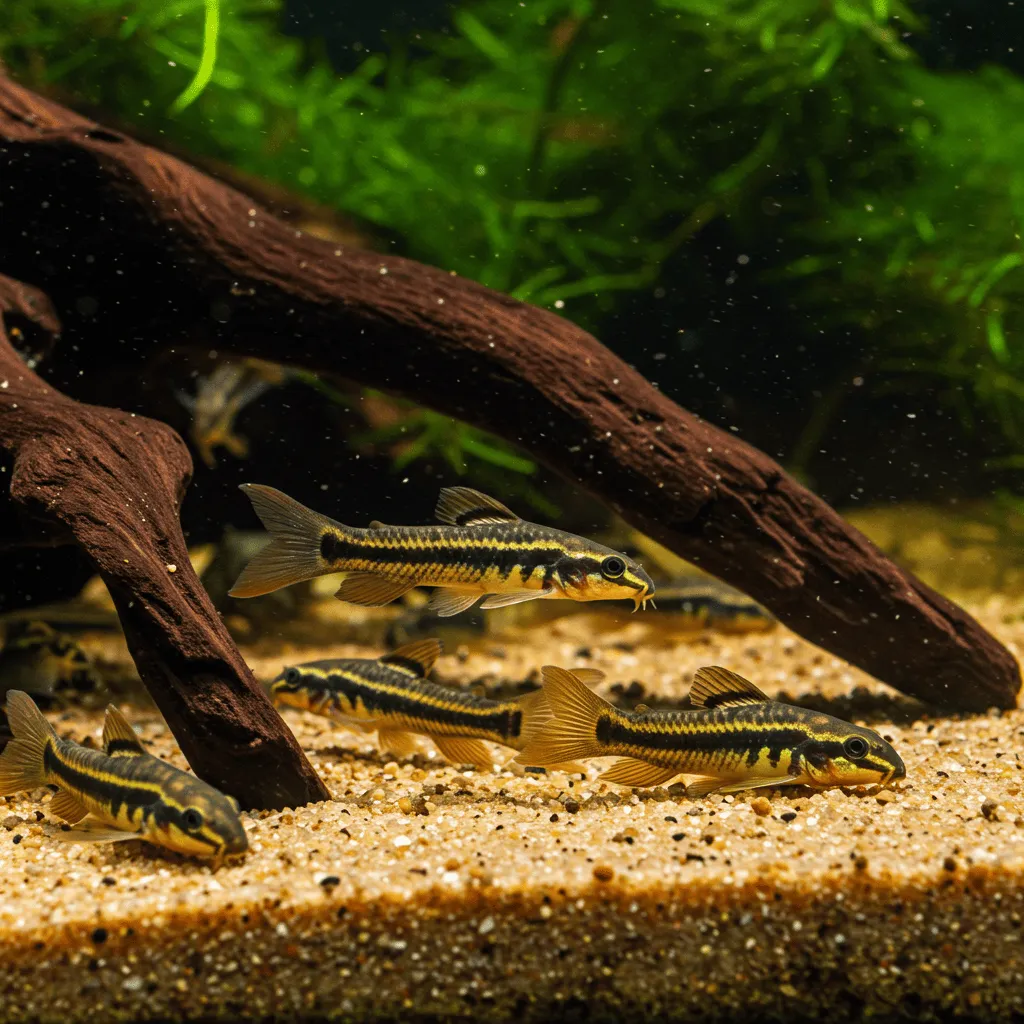
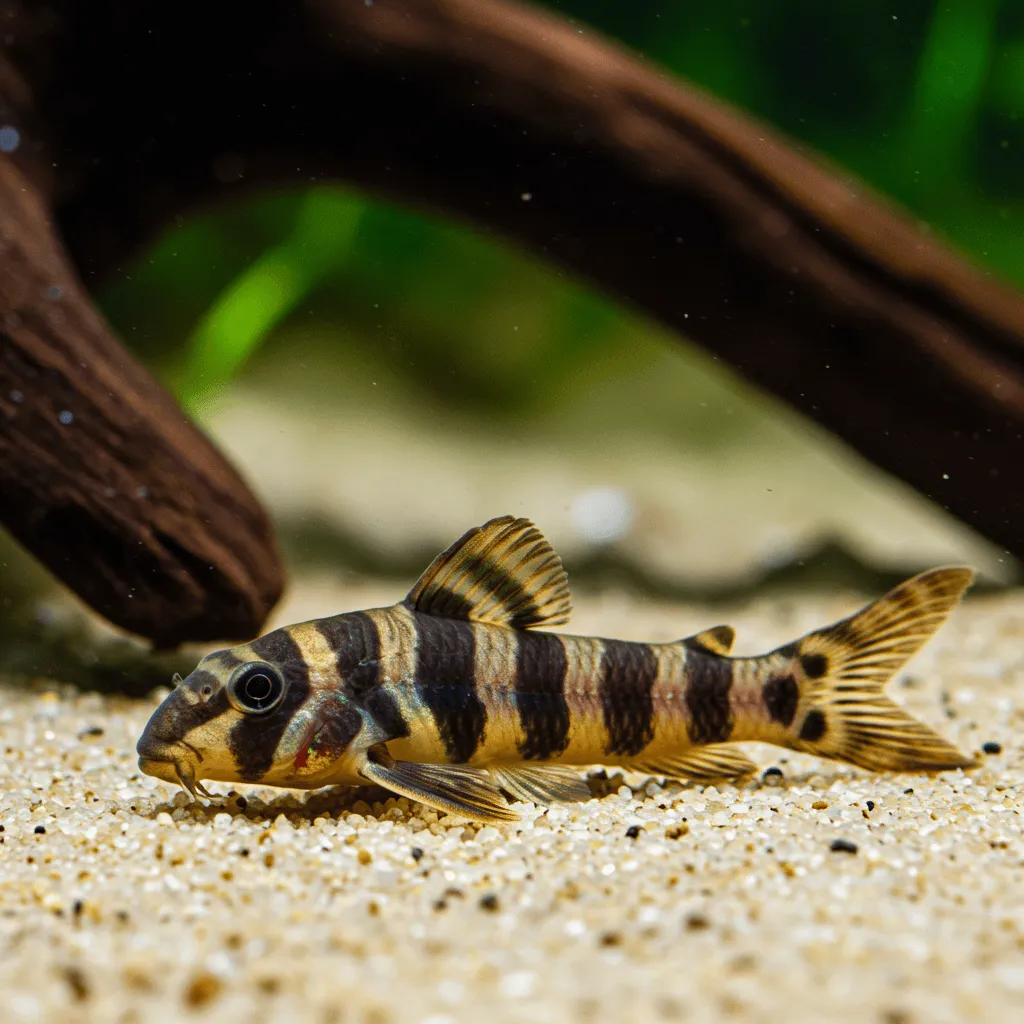
| Classic Kuhli Loach | Pangio semicincta / kuhlii | Yellow/orange body with 10–15 dark brown/black vertical bands |
| Black Kuhli Loach | Pangio oblonga | Solid dark brown/black body, eel-like |
| Silver Kuhli Loach | Various Pangio species | Pale tan/silver with faint banding |
| Chocolate Kuhli | Pangio spp. | Dark chocolate-brown body, sometimes faint stripes |
Regardless of exact species, all “Kuhli types” have similar care: soft substrate, hiding spots, peaceful tank mates, and a group of 6+.
Physical Characteristics
- Body: Slim, eel-like, laterally compressed
- Fins: Very small and subtle
- Mouth: Downturned with tiny barbels (whiskers) for sensing food
- Eyes: Small, often with a transparent protective scale
- Behavior: Wriggling, coiling around each other, “noodle piles” under decor
3. Tank Requirements & Setup
Kuhli Loach care is all about making them feel safe and giving them a natural environment to explore.
3.1 Tank Size
While they’re small, their social nature and active foraging habits require space:
- Minimum: 20 gallons (75 liters) for a group of 6+
- Better: 29–40 gallons (110–150 liters) for larger groups and tank mates
A longer footprint (more floor space) is better than a tall, narrow tank.
3.2 Substrate (Non-Negotiable)
Kuhli Loaches routinely dig and burrow.
- Best choice:
- Fine sand (pool filter sand, aquarium sand, smooth grain)
- Second-best:
- Very fine, rounded gravel (no sharp edges), but sand is strongly preferred
Avoid:
- Sharp gravel
- Crushed coral or aragonite
- Very coarse substrates that could damage their delicate barbels and skin
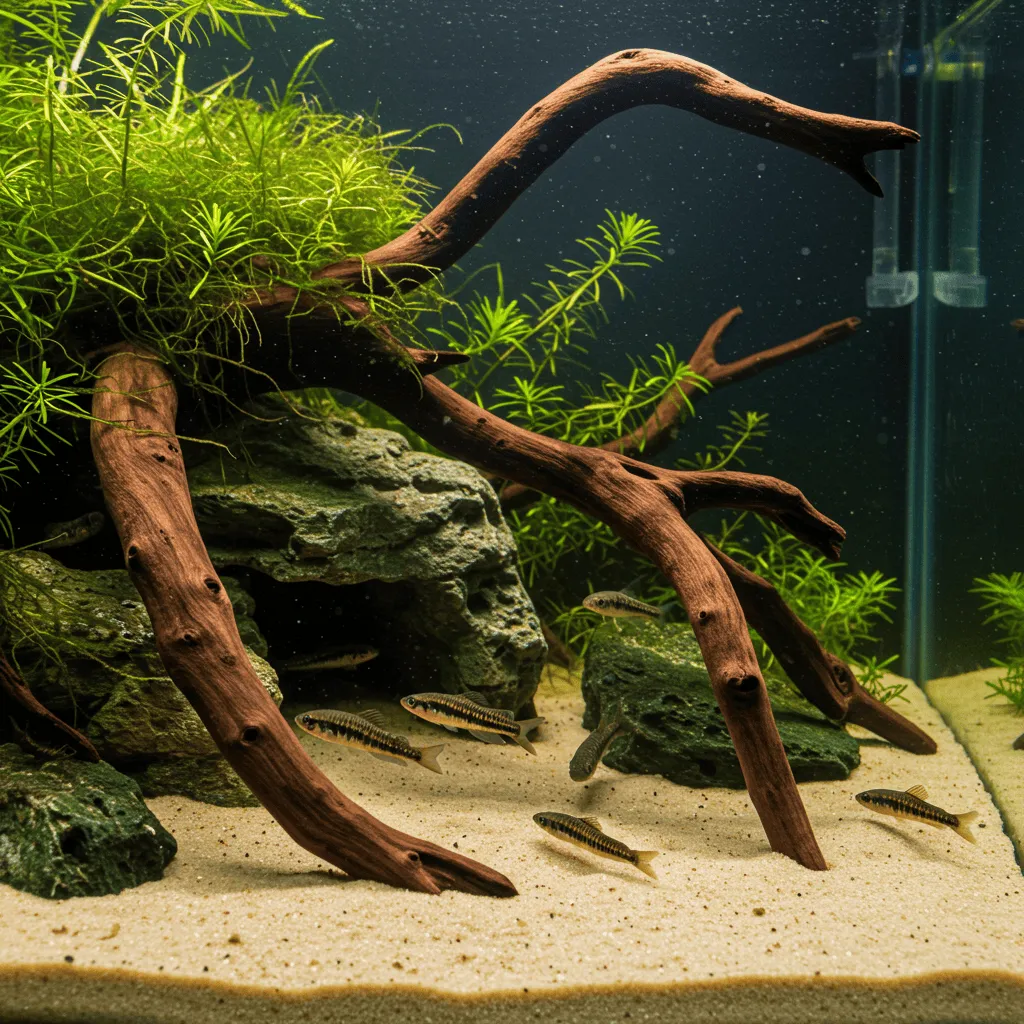
3.3 Hiding Spots & Decor
Kuhlis are shy, especially in bright light. You must provide:
- Driftwood tangles
- Rock caves / ceramic caves
- Coconut huts
- Dense plant roots and low foreground plants
- Leaf litter (e.g., Indian almond leaves or other safe botanicals)
The more hiding spots you create, the more you’ll see them—they feel secure enough to venture out.
3.4 Plants
Live plants greatly improve Kuhli Loach care:
- Offer cover and shade
- Create microhabitats rich in microorganisms
- Stabilize water parameters
Great plant choices:
- Java Fern
- Anubias
- Cryptocoryne
- Java Moss
- Amazon Swords
- Floating plants (Frogbit, Salvinia) for dim light
3.5 Filtration & Flow
Kuhlis like:
- Clean, well-oxygenated water
- Gentle to moderate flow
Use:
- A quality HOB (Hang-On-Back) or canister filter for main filtration
- Sponge filters as supplemental filtration and safe intake protection
Important: Cover filter intakes with a sponge or pre-filter—they can and will try to wiggle into tiny spaces.
3.6 Lid/Secure Cover
Kuhli Loaches are expert escape artists:
- Use a tight-fitting lid or glass canopy
- Block any gaps (around filters, airline tubing, etc.)
They can climb or jump through tiny gaps, especially when startled or during storms/pressure changes.
. Water Parameters & Maintenance Schedule
Kuhlis come from soft, slightly acidic, warm waters. Captive-bred fish are somewhat flexible, but stability is crucial.
4.1 Ideal Water Parameters
| Parameter | Recommended Range |
|---|---|
| Temperature | 75–82°F (24–28°C) |
| pH | 5.5–7.0 (up to ~7.2 if stable) |
| GH (Hardness) | 1–8 dGH (soft to moderately soft) |
| KH | 1–5 dKH |
| Ammonia | 0 ppm |
| Nitrite | 0 ppm |
| Nitrate | Ideally < 20 ppm (max ~30–40 ppm) |
They are very sensitive to ammonia and nitrite, and don’t appreciate high nitrates.
4.2 Maintenance Schedule
Daily:
- Quick visual check:
- Any unusual behavior (gasping at surface, frantic swimming)?
- Are they out after lights dim, foraging normally?
Weekly:
- Test: ammonia, nitrite, nitrate, pH.
- Perform 25–35% water change.
- Gently vacuum debris from the surface of sand (don’t plunge too deep).
Monthly:
- Rinse filter media in old tank water, not tap water.
- Inspect all seals, intakes, and lid gaps for escape risks.
- Trim plants; remove decaying leaves.
In Kuhli Loach care, consistency beats perfection. Avoid rapid parameter swings and big temperature jumps.
5. Diet, Feeding Schedule & Nutrition Tips
In the wild, Kuhli Loaches eat:
- Small worms
- Insect larvae
- Crustaceans
- Organic detritus
They’re omnivores with a strong preference for small, meaty foods.
5.1 Staple Foods
Because they live at the bottom and are often nocturnal, choose foods that:
- Sink quickly
- Stay in place for a while
Great staple options:
- Sinking micro pellets
- Sinking granules
- Quality bottom-feeder wafers
- Soft, small shrimp pellets
5.2 Treats & Variety
2–3 times a week, offer:
- Frozen (or live):
- Bloodworms (not too often, they’re rich)
- Daphnia
- Brine shrimp
- Tubifex / blackworms (ensure clean source)
- Gel foods or Repashy-style mixes (cut into bite-sized pieces and placed on sand)
They’ll sift through the sand to find leftover bits, but don’t rely on “leftovers only”—they need proper feeding.
5.3 Feeding Schedule
Kuhli Loaches are more active:
- Just after lights go out
- Early morning / late evening
Best practice:
- Feed main tank midday for other fish
- Then feed small sinking portions again at dusk or right after lights out so Kuhlis can eat without competition
Frequency:
- Adults: 1–2 small feedings per day
- Juveniles: Small portions 2–3 times per day
5.4 Recommended Brands (Affiliate-Friendly)
Some reliable foods for Kuhli Loach care:
- Hikari Sinking Wafers
- Fluval Bug Bites (Bottom Feeder or Micro)
- Omega One Sinking Shrimp Pellets
- New Life Spectrum Small Fish or Thera-A (sinking)
- Repashy “Community Plus” or “Bottom Scratcher” gel foods

6. Temperament & Tank Mates
6.1 Temperament
Kuhli Loaches are:
- Extremely peaceful
- Shy, especially when kept in too-small groups
- Curious and playful with their own kind
When comfortable, they:
- Form wriggling “piles” under decor
- Race along the bottom and through tunnels
- Forage constantly for microfoods
They rarely, if ever, harm tank mates.
6.2 Ideal Tank Mates
Choose gentle, peaceful fish that share similar water preferences:
- Small to medium tetras (neon, ember, rummy-nose, black neon)
- Rasboras (harlequin, lambchop, chili)
- Pygmy corydoras or other small Cory species
- Dwarf gouramis (honey, sparkling; avoid very aggressive types)
- Livebearers that like softer water (Endlers, some guppies)
- Otocinclus
- Dwarf rainbowfish in compatible water
Invertebrates:
- Amano shrimp
- Adult cherry/neocaridina shrimp
- Nerite and mystery snails
6.3 Tank Mates to Avoid
- Large or aggressive cichlids (Oscar, Green Terror, Convict, etc.)
- Large barbs, very boisterous danios, or fin-nippers in small tanks
- Big predatory catfish
- Very large goldfish (different temp and water needs, plus heavy waste)
Kuhlis do best in a calm, lower-stress community where they can forage without being harassed.
7. Breeding Kuhli Loach
Breeding Kuhli Loaches in home aquariums is possible but considered advanced. Most Kuhlis in the trade are wild-caught or bred in large-scale farms under controlled conditions.
7.1 Sexing Kuhli Loaches
Sexing is difficult:
- Females:
- Slightly plumper, especially when full of eggs
- Sometimes slightly larger overall
- Males:
- Slightly more slender
- Some species show subtle differences in the pectoral fin ray (hard to see)
7.2 Conditions for Spawning
Reported triggers include:
- Very clean, soft, acidic water (pH ~6–6.5, low GH)
- Warm temperature: 78–80°F (25.5–27°C)
- Dense plant growth and low light
- Regular feeding with high-quality live/frozen foods
- Large, cooler water changes simulating “rainy season”
7.3 Spawning Behavior
When they do spawn:
- Females may become visibly plump with greenish eggs visible inside.
- Eggs are often scattered among plant leaves, roots, or under decor.
- No real parental care; eggs and fry can be eaten by adults and tank mates.
7.4 Raising Fry
If you discover eggs or fry:
- Move decor with eggs/fry to a separate rearing tank with identical water.
- Use a sponge filter for gentle filtration.
- Provide moss and fine-leaved plants for microfauna.
- First foods should be:
- Infusoria
- Liquid fry food
- Then micro-worms, baby brine shrimp, and finely powdered foods.
Fry are tiny and delicate. Breeding Kuhlis reliably is more a project for advanced aquarists than beginners.
8. Common Diseases, Prevention & Treatment
Kuhli Loaches are scaleless (or very thin-scaled) fish. This makes them:
- More sensitive to poor water quality
- More sensitive to many medications
8.1 Common Issues
- Ich (White Spot Disease)
- Symptoms: White spots, flashing, rubbing on decor
- Loaches often show heavy infestations due to lack of scales.
- Bacterial Infections / Fin Rot
- Symptoms: Red patches, frayed fins, ulcers
- Often linked to substrate wounds or poor water.
- Parasitic Worms / Internal Parasites
- Symptoms: Weight loss, stringy feces, poor appetite.
- Stress from Poor Substrate
- Sharp gravel can cause physical damage and infections.
8.2 Disease Prevention
- Fully cycle the tank before adding Kuhlis.
- Maintain zero ammonia and nitrite; low nitrates.
- Use fine sand to prevent barbel and belly damage.
- Perform regular, moderate water changes—no giant, sudden changes.
- Quarantine new fish when possible to avoid introducing parasites.
8.3 Treatment Considerations
Because they’re scaleless:
- Avoid copper-based medications if possible.
- Use half-dose of standard meds if label warns about loaches/scaleless fish.
- Increase aeration during treatment.
- Always follow manufacturer’s directions and watch fish closely.
Example Disease & Treatment Table
| Disease | Common Symptoms | General Approach (Always Research Product) |
|---|---|---|
| Ich | White spots, flashing | Loach-safe Ich meds at reduced dose, gradual temp up |
| Fin Rot | Frayed fins, white edges | Improved water quality, mild antibacterial treatment |
| Fungus | Cottony white patches | Antifungal meds safe for scaleless fish |
| Internal Parasites | Weight loss, stringy feces | Targeted anti-parasitic meds (e.g., praziquantel) |
When in doubt, consult an aquatic veterinarian or experienced aquarist. Pristine water often does half the work in helping fish recover.
9. Where to Buy & Price Guide
9.1 Where to Buy Kuhli Loaches
- Local Fish Stores (LFS):
- Common source for standard banded and black Kuhlis.
- Online Retailers:
- Can offer multiple Pangio species and color varieties.
- Look for reputable sellers with live-arrival guarantees.
- Aquarium Clubs / Local Breeders:
- Occasionally, advanced hobbyists breed them.
- These fish are often more robust and acclimated.
9.2 Choosing Healthy Kuhli Loaches
Look for:
- Active behavior, especially at dusk.
- Plump, not emaciated, bodies.
- No sores, red patches, or visible parasites.
- Clear eyes, intact barbels and fins.
Avoid:
- Fish gasping at surface or lying motionless out in the open.
- Tanks with multiple dead fish or visible disease.
9.3 Price Guide (Approximate)
- Standard banded Kuhli Loach:
- Typically low to moderate price per fish.
- Black Kuhli / Pangio oblonga:
- Slightly higher in some regions.
- Rarer Pangio species:
- May cost more, especially wild-caught imports.
Prices vary by country, season, and availability, but Kuhlis are generally affordable.
10. Beginner Mistakes to Avoid
- Keeping Too Few Kuhli Loaches
- They are social; keep at least 6–8.
- Lone or pairs stay shy and stressed.
- Using Sharp Gravel Substrate
- Causes barbel damage, infections, and stress.
- Always use fine sand or very smooth fine gravel.
- No Hiding Places
- Bare tanks equal constant stress and very shy fish.
- Provide wood, caves, plants, and leaf litter.
- Adding Kuhlis to Uncycled Tanks
- They are sensitive to poor water; always cycle fully first.
- Overusing Harsh Medications
- Loaches and other scaleless fish are med-sensitive.
- Always check drugs are safe for loaches.
- Assuming They’ll “Clean the Tank” Completely
- Kuhlis eat leftover food but are not algae eaters.
- You still need to vacuum lightly and do water changes.
- Low Oxygen or High Temperatures + Poor Aeration
- Warm water holds less oxygen; ensure enough surface agitation.
11. Care Level & Difficulty Rating
- Care Level: Moderate
- Difficulty Rating: 5–6 / 10
Easier than many wild-caught, delicate fish, but not as foolproof as hardy livebearers or danios.
Best for:
- Beginners who already successfully maintain a cycled community tank.
- Intermediate keepers who want interesting bottom dwellers and are comfortable managing water parameters.
12. Pros, Cons & Final Verdict
Pros
- Unique, eel-like appearance and fascinating behavior
- Very peaceful and community-friendly
- Great for planted tanks with fine sand
- Long lifespan (8–10+ years) with proper care
- Fun to watch in groups and during nighttime activity
Cons
- Shy and often invisible in poorly designed tanks
- Require sand substrate and lots of hiding spots
- Sensitive to poor water quality and some meds
- Breeding is difficult for most hobbyists
- Can be escape artists if lids are not tight
Final Verdict
For aquarists willing to set up a soft, sandy, planted tank and maintain stable, clean water, the Kuhli Loach is one of the most rewarding, character-filled bottom dwellers you can keep.
If you:
- Keep them in a group of 6+,
- Provide fine sand and ample hiding spots, and
- Feed them properly with sinking foods,
you’ll be treated to years of funny, endearing behavior from these stripy nocturnal noodles.
13. FAQ Section (Frequently Asked Questions)
1. Are Kuhli Loaches good for beginners?
They can be, for motivated beginners who understand cycling and are willing to set up a sand-bottom, well-decorated tank. They’re not ideal for someone’s very first uncycled aquarium.
2. How many Kuhli Loaches should I keep?
At least 6–8 Kuhli Loaches. The larger the group, the more natural and confident their behavior.
3. What is the minimum tank size for Kuhli Loaches?
A 20-gallon (75-liter) tank is recommended for a proper group and some tank mates.
4. Do Kuhli Loaches eat algae?
Not really. They are not algae eaters. They scavenge leftover foods and hunt micro-invertebrates, but they won’t control algae like Otocinclus or Bristlenose Plecos.
5. Can Kuhli Loaches live with shrimp?
Generally yes, especially with adult shrimp like Amano or adult Neocaridina. They may eat a few shrimplets, but they are not efficient shrimp predators.
6. Do Kuhli Loaches burrow?
Yes. They love to dig and sometimes partially bury themselves in soft sand. This is normal as long as the substrate is safe and they aren’t gasping or showing other distress signs.
7. How long do Kuhli Loaches live?
With good care, they can live 8–10 years or more, making them a long-term commitment.
8. Are Kuhli Loaches nocturnal?
They are most active at night and at dawn/dusk, but in comfortable, safe tanks, you’ll often see them out during the day as well.
9. Do I need a heater for Kuhli Loaches?
Yes, in most homes. They prefer 75–82°F (24–28°C), so a heater is strongly recommended unless your room remains very stable and warm year-round.
10. How can I see my Kuhli Loaches more often?
- Keep a larger group (6–10+).
- Provide plenty of hiding spots (counterintuitive, but it works).
- Use dim or diffuse lighting and floating plants.
- Feed small sinking foods at dusk— they’ll quickly learn feeding times.